
By nature, every workforce dataset tells only a partial story. Labor market reports show where jobs are, or who is working and who isn’t. Job board data shows what workers are searching for. Survey data captures workers’ sentiments. But the full picture? Whether a worker who started exploring career options three years ago actually landed a better job, stayed in it and is seeing increased economic mobility — that story is much harder to tell.
At SkillUp, we've spent years building a data infrastructure designed not only to serve our platform users, but also to answer harder questions about economic mobility for STARs. We know safe data collaboration is critical to tell the full story, so we share our infrastructure with research partners, policy institutions and fellow workforce practitioners to help the broader field understand what works and, equally important, what doesn’t.
Let’s dig into three distinct data collaborations, each of which uses SkillUp's data differently, producing insights that wouldn't have been possible in isolation.
Measuring Where STARs Land with LinkedIn
Through a collaboration with LinkedIn, we’ve been able to produce a deep, longitudinal look at career outcomes for SkillUp users. By matching approximately 80,000 anonymized and de-identified SkillUp user profiles against LinkedIn career data — meaning there is no personal information transferred — we can examine which careers platform users actually ended up in and what factors shaped outcomes over time.
The findings challenge some assumptions: employment rates are roughly similar across education levels, though users with a bachelor's degree do hold advanced roles at a modestly higher rate. The difference is real but smaller than conventional wisdom suggests.
Unsurprisingly, geography also influences outcomes. Higher-wage metros like the San Francisco Bay Area and Washington D.C. show stronger concentrations of advanced roles and salaries above $60,000, while most other metros skew heavily toward entry-level positions.
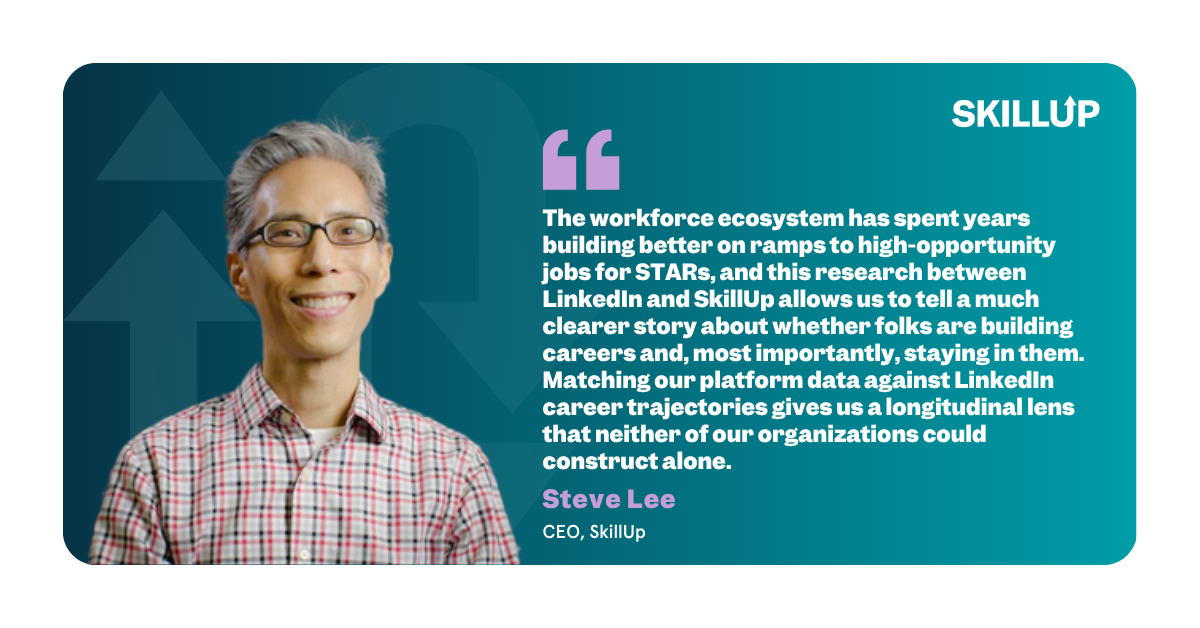
"The workforce ecosystem has spent years building better on ramps to high-opportunity jobs for STARs, and this research between LinkedIn and SkillUp allows us to tell a much clearer story about whether folks are building careers and, most importantly, staying in them," says Steve Lee, CEO of SkillUp. "Matching our platform data against LinkedIn career trajectories gives us a longitudinal lens that neither of our organizations could construct alone."
Giving Human Voice to Aggregate Data with the Atlanta Federal Reserve
Our Pulse Survey, administered three times a year with a sample size of 18,000 voices, has become a resource for external researchers, too. The Atlanta Federal Reserve has drawn on our qualitative worker data to complement Bureau of Labor Statistics figures, using STARs' firsthand accounts of job searching, economic sentiments and career decision-making to give human texture to what otherwise can feel like abstract labor market trends.
The Fed's work is a useful illustration of what makes SkillUp's survey data genuinely distinct. It's longitudinal, it's specific to nondegree workers and it goes beyond capturing only employment status to add the experiences and sentiments that drive behavior. When national employment numbers shift, SkillUp's data helps explain why workers are responding the way they are: what they're worried about, what's motivating them, where they feel stuck.
Raising the Bar on AI Evaluation with MDRC
Another consequential collaboration is with MDRC, a leading nonpartisan research organization, on an independent evaluation of SkillUp's AI tools. While many career navigation platforms are building AI capabilities with limited external scrutiny and base success on whether users engage with the tools, we engaged MDRC to rigorously assess whether our AI is actually improving users’ outcomes.
The resulting research contributes to a broader industry conversation about what responsible AI evaluation looks like in workforce contexts. Our own evaluation framework for AI systems, built with zero external dependencies, allows us to test AI interactions against defined quality standards before deployment. Sharing the methodology publicly is a deliberate choice, because we believe the workforce ecosystem benefits when platforms are transparent about how they measure their own tools.
Across all three collaborations, the throughline is that SkillUp's data is most valuable when it's in conversation with other data. “When SkillUp's data sits alongside LinkedIn's career data, the Atlanta Fed's labor analysis, or MDRC's AI evaluation research, our collective work gets sharper,” says Lee. “We can see not only where workers land, but also what influences career progression and wages over time. That kind of intelligence lets platforms like SkillUp, as well as the partners we collaborate with, stop guessing about what is needed and put our energy into the solutions we know create impact.”
Data as a public good doesn't mean sharing everything, but it does mean sharing the right things, with the right partners, in ways that help us all make better decisions for learners, workers and job seekers. That's the work we're committed to, one data collaboration at a time.