Earn and learn jobs combine paid employment with on-the-job training or financial help for education. You can build skills while working, rather than funding every step of a career change yourself. At SkillUp, we curate these Earn and Learn opportunities for people looking for a career that doesn't require a college degree.
The right opportunity has to do more than advertise "training provided." It should include work you're interested in, pay that fits your needs, and learning benefits you can use.
What Is an Earn-and-Learn Job?
An earn-and-learn job makes learning part of your employment. Depending on the employer, that can mean training for the position you're hired to do, help paying for more education, or both.
On SkillUp, our Earn and Learn opportunities must provide on-the-job training or financial assistance for credentials, training, or tuition. We also look for full-time positions with benefits and a livable wage, no college degree needed, and openings that range from no experience to some general work history.
The learning benefit usually takes one of two forms.
Learn the Job After You're Hired
With paid on-the-job training, you learn the employer's processes and the skills required for your position as you work. Training might include instruction, practice, and guidance from experienced coworkers. AT&T, for example, describes paid training for its Tulsa call-center employees that covers company systems, customer service, and on-the-job coaching.
Look for an explanation of what you'll learn, who will support you, and how the employer decides when you're ready to work on your own.
Get Help Paying for Education
Other employers provide learning benefits that support courses, certifications, or added education while you stay employed. AT&T's call-center benefits, for example, include tuition assistance, reimbursement for eligible certificates, and job training.
Financial assistance isn't always unlimited. UPS's Earn & Learn tuition-assistance program advertises up to $5,250 per calendar year and a $25,000 lifetime maximum at participating locations, which shows how an education benefit can help without covering every possible expense.
Before relying on a benefit, ask whether the company pays upfront or reimburses you, which programs qualify, and whether classes happen during paid hours or on your own time, since a benefit can cover tuition without paying you to attend.
Why Choose an Earn-and-Learn Job?
An earn-and-learn job may be a good fit when you need employment now and want it to help you prepare for something more. Look for a role that supports both your work and your learning.
There's also a practical advantage to learning through the work itself. Customer service trainees, for example, learn how to answer questions, use company systems, and handle situations as they arise under the guidance of experienced workers. That gives you concrete responsibilities and skills to describe in your next application, which a course title alone can't.
But choose the job as carefully as the benefit. An education allowance won't make an unsuitable schedule manageable, and training won't automatically produce a promotion. Ask what the learning prepares you to do and what employees need to demonstrate before moving into other roles.
What would make a new job workable for you right now: a minimum hourly rate, predictable hours, a shorter commute, or a particular kind of work? Start with those needs. Our career paths can help you compare daily responsibilities, skills, and possible next steps before you narrow your search to individual openings.
And check your current employer's benefits before assuming you need to leave. Ask whether it provides job shadowing, tuition assistance, certification funding, or training for another position. You may still decide to move, but you'll be comparing your true options.
Earn and Learn on the SkillUp Platform
Earn and learn roles are only about 5% of the SkillUp catalog, but that 5% has added up to more than 32,000 jobs over the last three years. And 24% of every job referral we've made has gone to one of them, which tells you people are seeking this kind of opening on purpose, not stumbling into it.
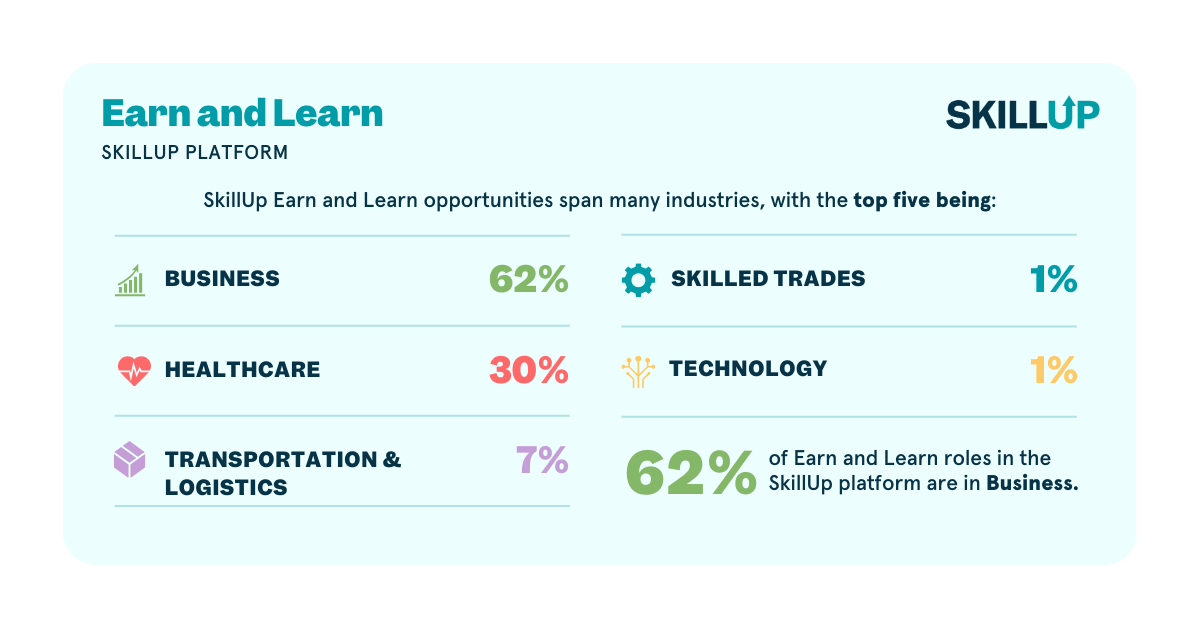
The openings cluster in a few fields. Business leads at 62%, healthcare at 30%, and transportation and logistics at 7%, with skilled trades and technology splitting the last two points. You can see the current picture any time on the Earn and Learn page and filter from there.
Location matters too. Earn and learn openings concentrate in the Midwest and South, with Detroit, Chicago, Houston, and Dallas near the top of the list. And a third of the people we've referred to these roles are between 18 and 24, so if you're early in your career, you've got plenty of company here!
Which Earn and Learn Jobs Pay Well?
We chose these career areas to show different kinds of E&L work: investigating claims, delivering mail, installing equipment, supporting healthcare, and helping customers. The employer examples show what to look for even when you don't live near a featured opening.
The five roles at a glance:
- Claims adjuster: $78,000/year. The highest ceiling; you investigate and settle insurance claims.
- Postal service worker: About $60,550/year for mail carriers, the largest postal role. Steady public-sector work, indoors at a counter or out on a route.
- Solar installer: $53,140/year. Hands-on and fast-growing, with most skills learned on the job.
- Healthcare administrative support: $45,930/year. Office work in a growing field where customer-facing experience transfers.
- Customer service representative: $21.53/hour. The widest availability, and a common first job or industry switch.
Wages here are national medians from the Bureau of Labor Statistics' Occupational Employment and Wage Statistics (OEWS), May 2025. A median is the midpoint, not a starting wage, so entry pay is usually lower. Employer examples were checked in September 2026. And a job title alone doesn't make a position an E&L opportunity: read the posting for the training or education benefit, then check the experience terms and employment conditions.
Claims Adjuster
Median pay: $78,000/year · Training: on the job, under a senior adjuster · Good fit if: you like digging into details and explaining decisions.
Claims adjusters investigate insurance claims and decide whether a loss is covered and how much the insurer should pay. Entry-level adjusters usually begin with smaller claims under an experienced worker's supervision, then take on more complicated cases as they learn. A high school diploma or equivalent is typically enough to start, though some employers want a degree or insurance-related experience, and licensing rules vary.
Search for trainee openings, compare them against related roles on our career paths, then ask whether the employer supports any licensing preparation and fees. Read titles carefully, too: a position called "claims specialist" may carry different duties from an adjuster role, so don't assume the same salary or training applies.
Postal Service Worker
Median pay: about $60,550/year (mail carriers) · Training: several weeks on the job · Good fit if: you want steady work with clear benefits.
Postal work includes delivering mail, assisting customers at a postal counter, and sorting or processing mail. Mail carriers, the largest of these roles, earn a median of $60,550 a year, with clerks slightly higher and sorters slightly lower. New employees generally receive several weeks of on-the-job training, and beginning carriers may work alongside an experienced carrier. The environment depends on the position: carriers spend much of their time outdoors, while clerks and mail-processing workers usually work indoors, and driving positions add a driver's license and a safe driving record.
Before comparing offers, check whether it's a career or noncareer appointment, since those categories have different employment terms and benefits. Ask about expected hours, scheduling, training, and eligibility for benefits instead of assuming every opening comes with the same arrangement.
Solar Installer
Median pay: $53,140/year · Training: on the job, up to a year · Good fit if: you like physical, hands-on work.
Solar photovoltaic installers assemble, install, and maintain systems that turn sunlight into electricity. Workers can learn alongside experienced installers, with training covering safety, tools, and installation techniques. If you want to cover some of that groundwork first, our training catalog lists solar and construction programs by cost and length.
Sunrun shows one example of an employer-supported route. Its installer posting in Des Plaines, Illinois, lists paid training and says previous solar, construction, or military experience is preferred, not required. Read the physical demands closely: that posting includes work on roofs, ladders, and in confined spaces. Ask about travel between job sites, equipment you'll need, and the support available to new installers. You don't need to live in Illinois to use the example. Look for the same details in local postings: what experience a job truly needs, what the employer teaches, and whether training is paid.
Healthcare Administrative Support
Median pay: $45,930/year · Training: on the job, plus medical terminology · Good fit if: you have customer-facing experience to bring over.
Healthcare organizations need people to coordinate appointments, maintain information, process paperwork, and support communication. Medical secretaries and administrative assistants need familiarity with medical terminology and office procedures, which may require additional training beyond general administrative work. To see how the role compares with other healthcare support roles, browse our career paths.
Related titles can carry different duties and terms. A recent CVS Health care-management associate posting described four weeks of training, followed by eight weeks of work with a trainer. It also expected two years of experience in customer service, telemarketing, or sales, rather than requiring applicants to have already held that exact healthcare role. That distinction helps when you're changing industries: your customer-facing experience may meet a condition even when healthcare is new to you.
Compare the responsibilities and pay for each posting. Don't apply the medical-administrative-assistant wage to every "coordinator" or "care management" title, and check whether a position is administrative support or needs clinical qualifications.
Customer Service Representative
Median pay: $21.53/hour · Training: short-term, 2 to 4 weeks · Good fit if: you're starting out or switching industries.
Customer service representatives answer questions, resolve problems, and help people understand products or services. These jobs typically need a high school diploma or equivalent and provide on-the-job training. If a posting requires a credential you don't yet hold, our training catalog lists customer service and office programs by cost and length.
An AT&T posting in Charlotte, North Carolina, shows how one posting can differ from the national figure. It advertised $19.41 per hour, paid training, and a 40-hour workweek, and combined customer assistance with sales and retention duties. Look beyond the title when choosing a customer-service job: check whether the work means phone calls, chat, sales targets, technical troubleshooting, or collections, and ask how performance is measured and whether the schedule includes evenings or weekends.
Who Qualifies for Earn and Learn Jobs?
You don't need a college degree for the E&L jobs we feature on SkillUp. Some employers accept applicants with no work experience; others expect general work history. That differs from expecting experience in the occupation you're trying to enter.
Changing industries doesn't erase your experience. Someone who has handled customer complaints, explained products, or learned a point-of-sale system should compare those duties with a posting's communication, problem-solving, and computer needs. Judge yourself on the duties you've performed, not the title you held.
Read "required" and "preferred" separately, too. Sunrun's installer example treats previous solar or construction experience as a preference, while AT&T's Tulsa call-center information says customer-facing experience is preferred but not mandatory. Neither statement means you should invent experience. Read the line as written.
Other conditions still matter. A job may specify a high school diploma, a license, particular computer skills, or availability for a fixed schedule. Identify those before spending time on an application.
When you need help explaining your background, our resume and interviewing guide walks through choosing relevant skills and describing your experience. You're showing that you can learn and contribute, so keep the description true to the job you did.
What Should You Check Before Accepting?
Start with the job posting, then use the interview and the written offer to fill in the gaps. "Training provided" tells you about as much as "competitive pay," useful as a signal, not a plan.
- Confirm the pay during training. Ask for the starting rate, expected hours, first payday, and any change in pay after training. Separate base pay from bonuses, commissions, and overtime when deciding whether the job fits your budget.
- Get the covered costs in writing. Ask about tuition, exams, books, tools, and other expenses you'd carry. For reimbursement, confirm what you must pay upfront and when you can expect payment.
- Check the entire schedule. Ask whether training hours differ from the regular work schedule, whether attendance is mandatory, and whether classes or study time happen outside paid hours. Include commuting and caregiving needs in your comparison.
- Understand what the training leads to. Will you learn an employer's internal systems, earn an outside credential, or prepare for another position? Ask what support is available if you need more practice or don't pass an assessment.
- Read the commitments and benefit rules. Check eligibility dates, funding limits, any continued-employment conditions, and what happens if you leave or don't complete the training. Request a copy of the policy before committing.
A useful interview question: "What will I learn during training, which costs does the company cover, and what would I need to demonstrate to move into the next role?"
You can also ask who trains new employees and what happens after the initial training period. Those answers help you tell a concrete learning plan apart from a vague promise of "growth opportunities." They're also worth bringing to free career coaching if you want a second read on an offer.
Be cautious about anyone asking you to pay for the promise of a job. The Federal Trade Commission warns against supposed employers who send a check and ask you to forward the money or use it to buy equipment. Verify suspicious requests using contact information you independently find for the employer.
How to Find and Apply for Earn and Learn Jobs
Start With E&L Openings
Begin with SkillUp's Earn and Learn job listings, which already have the E&L filter selected. Focus first on work you can realistically reach and schedules you can manage.
We're a nonprofit career platform, not the employer or training provider. Our part is to help you find and compare openings. The employer manages hiring, and the employer or its training partner provides the learning.
Don't limit your search to the words "earn and learn." When reviewing employer career pages, also try your target occupation alongside "paid training," "trainee," "training provided," or "tuition assistance." Treat those terms as clues to investigate, and confirm each posting against your needs.
Compare the Job With Your Background
Choose a few promising openings and sort their conditions into what you already have, what the employer will teach, and what you would need before starting.
Before paying for a credential, check whether it's needed or only preferred and whether the employer provides the relevant training. You may find another E&L opening that better matches your current qualifications.
When a credential truly is needed, use our training catalog to compare options by cost, length, and format. Use it to close a qualification gap you've found, not to add a step just in case.
Prepare the Requested Application Materials
Match your resume to the work in the posting. Show relevant responsibilities, tools you've used, and examples of learning something new. Include a cover letter when requested or when it gives you room to explain a career change.
For example, a retail worker applying for customer support might describe how they resolved customer concerns, explained product options, and recorded follow-up information. Use that approach only where it reflects your experience.
You don't need to claim you already know everything the employer plans to teach. Show what you bring and why the work interests you.
Apply Through the Employer's Process
Follow the application instructions and save the job title, employer, date, and any confirmation details. Direct questions about an application or hiring decision to the employer, since SkillUp doesn't make those calls.
Feeling unsure about which roles to pursue? Our free career coaching resources can help you work through your next move. You don't have to sort through every option alone!
Find an E&L Job That Fits Your Next Step
Choose a career area that interests you, name the pay and schedule you need, and look for an employer that explains how it will help you learn. You don't need to commit to a course before you've checked whether a suitable job will provide the training.
Browse Earn and Learn jobs, then create a free SkillUp profile to save the openings you want to compare and track your applications. The platform is free, so you can weigh your options without adding another cost to your career change.
Frequently Asked Questions
Can you earn and learn from home?
Yes, some employers post remote jobs with paid training. CVS Health has advertised remote call-center positions that include a paid training period, though that doesn't indicate how many such openings exist at any given time. Check our remote E&L listings, then confirm the residence rules, training hours, equipment needs, and any in-person attendance requirements. "Remote" shouldn't be your only scheduling question.
How long does earn and learn training take?
There isn't one standard length. The Bureau of Labor Statistics describes typical customer-service training as two to four weeks, while on-the-job training for solar installers can last up to a year. Those are occupation-level descriptions, not timelines for every employer. Ask about initial training, supervised practice, and the point at which you're expected to work on your own. An ongoing education benefit may follow a different timeline from training for the job itself.
Will you earn a certificate?
Not always. SkillUp's E&L category includes both on-the-job training and financial assistance for credentials or education, so a job can qualify without promising a separate certificate. Ask what you receive after completing training, who issues it, and whether other employers recognize it. Employer-specific knowledge and outside credentials can both help, though they aren't interchangeable.
How is an earn-and-learn job different from an apprenticeship?
They overlap, but not every E&L job is an apprenticeship. A Registered Apprenticeship combines paid work, mentoring, classroom instruction, rising wages, and a nationally recognized, portable credential. General E&L openings don't always include all of those. When comparing opportunities, ask how their training is organized, since the label alone won't tell you.