You spend weeks polishing a résumé, lining up references, and prepping for interviews, all to answer “Will they even hire me?” But once you’re in, a bigger question is waiting: “Will this job take me anywhere?”
Imagine two people who start as customer service reps at the same company on the same day, fresh out of retail and ready for something steadier. Five years later, one has been promoted twice and trained in a specialty. The other is doing the same job for the same pay. What happened? More often than not, the difference comes down to the employer, not the person.
A new project called Where You Work Matters set out to measure that difference. Here’s what it found and how you can use it to pick employers that pull you forward instead of leaving you stuck.
What Is Where You Work Matters?
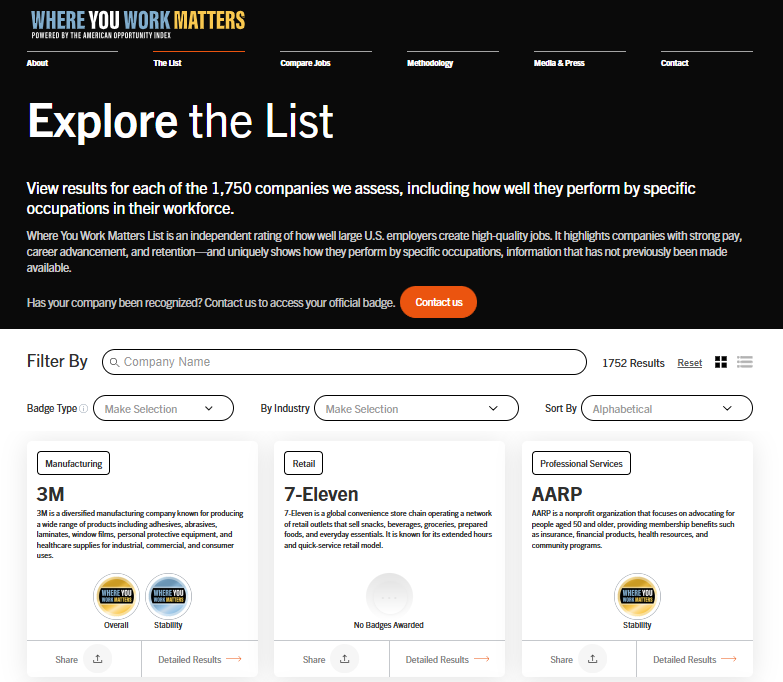
Where You Work Matters (WYWM) is an independent rating of how well the largest U.S. employers create good jobs. It’s the 2026 expansion of the American Opportunity Index, developed by a research team that includes the Burning Glass Institute, Schultz Family Foundation, and Harvard Business School.
If the Burning Glass Institute rings a bell, that’s because SkillUp already works with them on the Credential Value Index, which rates training credentials by how much they lift workers’ wages. WYWM uses the same outcomes-first approach, but this time it’s focused on employers instead of training providers.
Unlike the company reviews you’ve scrolled through elsewhere, it doesn’t run on surveys, star ratings, or anonymous posts from someone having a bad day. It tracks what happened to more than 12 million workers over time, through job postings, résumés, and public professional profiles. The List covers 1,750 large employers and rates more than 55,000 jobs inside them.
It doesn’t ask employees how they feel about their company. It looks at whether people got promoted, got paid well, and stuck around.
What Defines a Good Job?
Where You Work Matters sorts good jobs into three types:
Early Career: Rewards employers that hire and train people early, even without a degree or a long résumé. Best if you’re starting out or breaking into a new field.
Growth: Rewards promotions and skill-building from within, instead of always hiring managers from outside. Best if you want to climb, not plateau.
Stability: Rewards above-average pay and strong retention over time. Best if you want a steady role worth staying in.
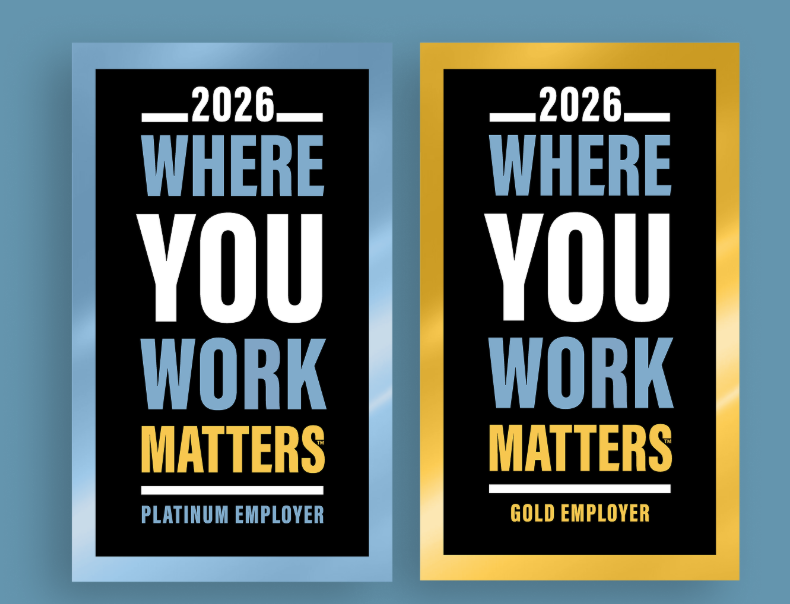
For each type, the top 20% of employers nationally earn a Platinum badge, and the next tier (the top 20% to 40%) earns Gold. A company can sweep all three or shine in just one.
Why the Early Career Badge Matters Most for Entry-Level Workers
If you’re fresh out of high school, switching industries, or building a career without a four-year degree, Early Career is the badge you need to focus on.
It flags the employers most open to hiring people early, then giving them the training and the room to move up. That’s the whole ballgame when you’re trying to climb the ladder somewhere that won’t leave you stranded on the bottom rung.
It also lines up with what SkillUp does. Every career, training program, and job on our platform earns its spot because it leads somewhere without demanding a degree first. WYWM’s Early Career data helps you identify which employers turn a first job into a career with a future.
Why Job Quality Depends on the Role
WYWM rates jobs by role, not just by company. That matters because the same employer can be excellent for one job and mediocre for another. A company might be a top performer for entry-level IT support while there’s very little movement in its warehouse or retail roles. A well-known logo on a job posting doesn’t guarantee the role behind it goes anywhere.
So a smaller, less famous employer can be a stronger bet for your particular job than a household name. Many people learn that kind of detail after a few years in their industry, but now you can check it before you ever apply.
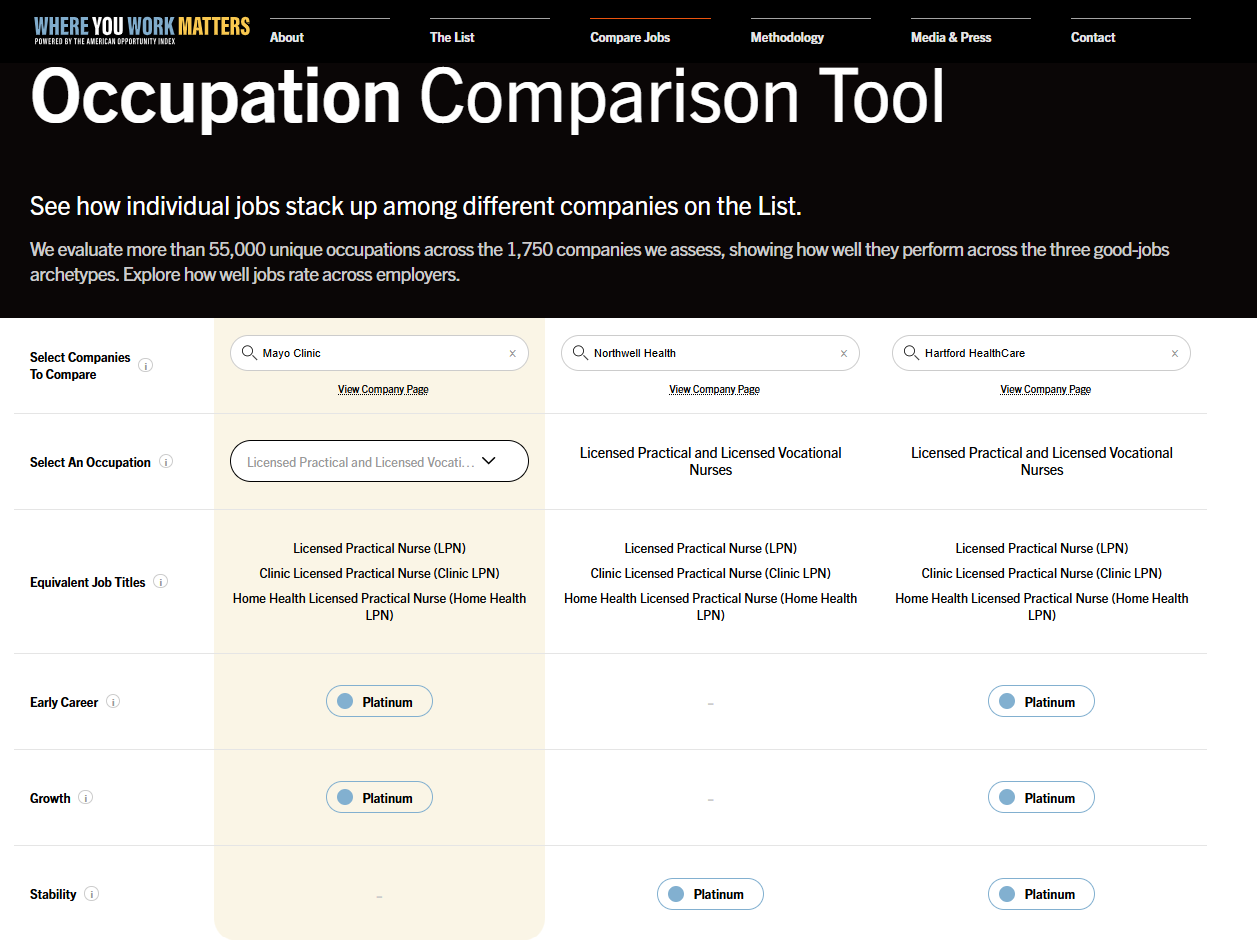
Try it on a company you’re eyeing. Open the Compare Jobs tool, type in the employer, find your exact role, and read its badge. In about a minute, you’ll know whether that role is a place people grow or a place they get stuck.
Which Companies Are Best for Starting a Career?
Twenty-two companies earned Platinum across all three categories at once, which means they’re strong on Early Career, Growth, and Stability. Many of them hire for the kinds of entry-level, apprenticeships and no-degree roles SkillUp users search for every day.
Mayo Clinic and Northwell Health: Two of the country’s largest health systems, with entry points into patient care, administrative, and support roles.
Progressive: A big hirer for customer service, loan officers, insurance agents and claims roles, the kind of business jobs that can start with on-the-job training. You’ll also find some skilled trades pathways with Progressive like safety coordinators and electricians.
These are illustrative, not a shopping list. They share a pattern, though: large operations with a track record of bringing people in early and moving them up. You can browse the full set on the Where You Work Matters list.
The overlap with our own catalog runs deep, too. Of the 517 employers that earned Platinum or Gold for Early Career, SkillUp already features 385 of them, about 74%, in our jobs catalog. Many of the employers most likely to give you a fair shot are already a click away on our platform.
What That Looks Like in Practice
Say a big health system like Mayo Clinic or Northwell Health catches your eye. One of the most common no-degree ways in is a Licensed Practical Nurse (LPN) role. SkillUp takes you from curious to applying in three steps:
Start with the role: Our Licensed Practical Nurse career page lays out the day-to-day and shows you can train in under a year for a job that pays around $55,000.
Find the training: Browse healthcare training that leads to the credential. Make sure to look for programs that are short and low-cost.
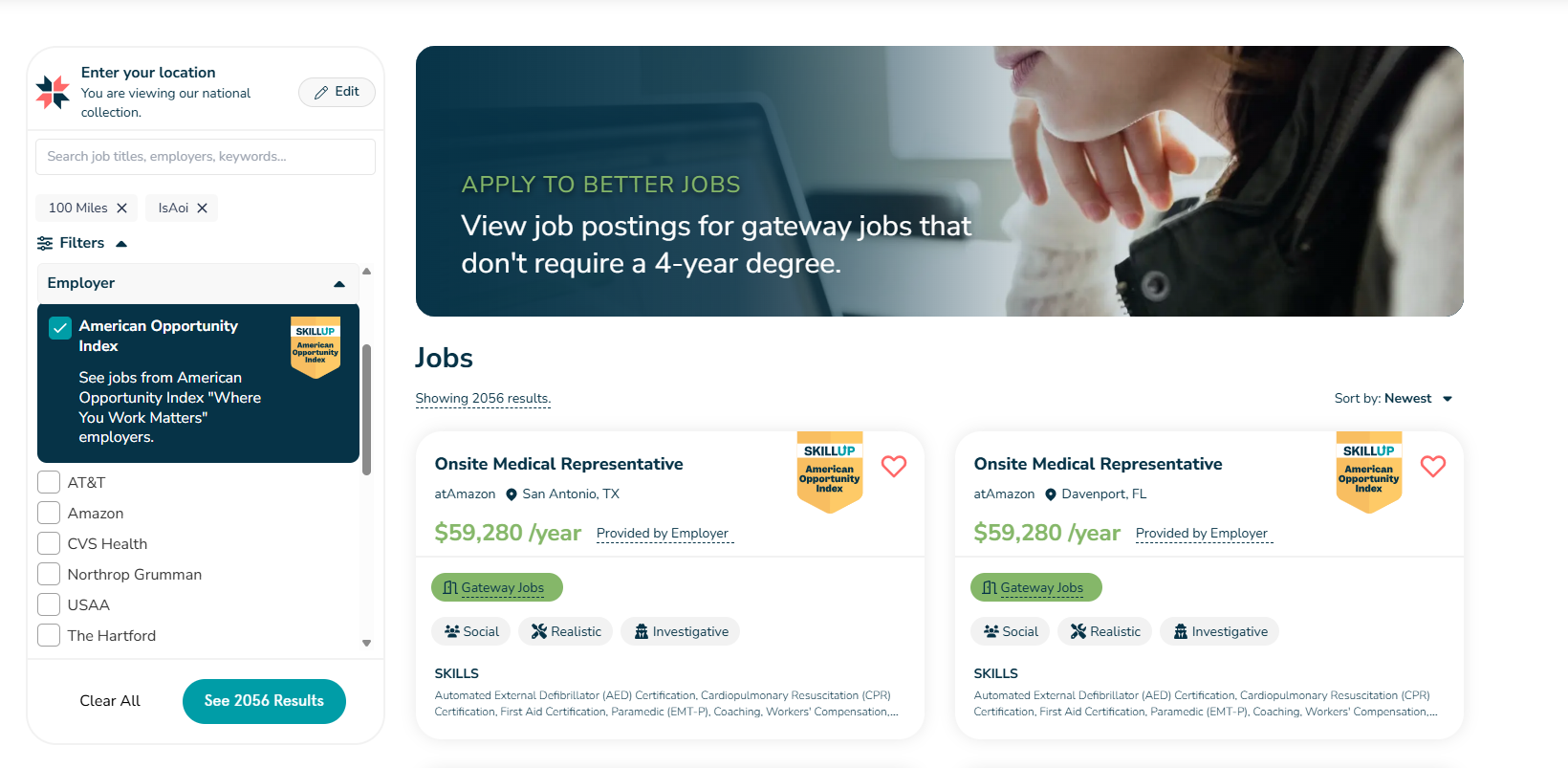
Find the job: When looking for jobs in SkillUp's platform, you can easily filter by the top-ranked WYWM employers by selecting the American Opportunity Index filter.
Save your plan: Create a free profile to keep the role, training, and jobs in one place and track your applications as you go.
That’s the whole point of pairing WYWM with SkillUp. You get a research-backed employer, an accessible entry role, and a step-by-step pathway, all in a few clicks.
How to Use Where You Work Matters in Your Job Search
You can get started using WYWM right away by adding these steps to your job search:
Look past the logo: When a job catches your eye, ask where the role leads, not only who’s hiring. A famous company isn’t automatically a good place to be in your role.
Rate a first job by where it goes: An entry-level job at an employer that promotes from within can beat a slightly better-paying job that dead-ends.
Stack the deck before you apply: A short credential can bump you to the front of the line. SkillUp's training catalog is full of programs you can finish in weeks or months, and plenty of them are free or low-cost.
SkillUp’s platform is here to help you. If you’re not sure what direction fits you, the Work Styles Quiz points you toward careers that match how you operate. From there, career paths break down what each job is like and how to train for it, and the job board is filtered to roles that pay a living wage and skip the degree requirement. When you create a free profile, you can save the careers, training, and jobs you’re eyeing and pick up where you left off later.
Find an Employer Who Helps You Grow
Where You Work Matters nudges you to think beyond “I have to get hired” and consider “Where will this role take me?”
You deserve a job that does more than fill your calendar. You deserve one that builds on itself, pays you fairly, and still wants you around in three years. Data like this helps you spot those jobs before you sign on instead of finding out the hard way.
Ready to find employers that grow people like you? Create your free SkillUp profile and start exploring careers, training, and jobs focused on getting ahead without a four-year degree.
Ready to find an employer that grows people like you?
Don’t settle for a job that just fills your calendar. Use data-backed insights to find roles that pay fairly, offer a clear path for advancement, and are open to people without a four-year degree. Your next career move should be an investment in your future.
Sign up for a free purpose coaching session this October. Skip the degree wall, unlock your strengths, and map out your next logical step with zero paywalls.