Career navigation is hard. The process involves numerous steps that require job seekers to make complex decisions, including picking a career to pursue, figuring out what skills are needed, finding training to get those skills, identifying what jobs to apply for, and demonstrating value to and getting hired by an employer. The shifting and often unpredictable nature of local labor markets makes this process even more challenging, leaving many people stuck in low-wage work or finding themselves in need of a career pivot.
Evidence shows that career guidance support, including career coaching and advising, can provide value to job seekers by helping them clarify a career path or connect to a job or training program that can improve their financial situation.¹ But individual career coaching is labor-intensive, requires knowledge of many careers and local economies, and is not readily available to all job seekers. Individuals who have lower incomes often have a harder time accessing career coaching and may not have the benefit of receiving career guidance from friends and family members.
Generative artificial intelligence (or AI) has the potential to overcome these challenges. AI tools may be able to provide instant, personalized guidance and support to users, ultimately helping them take the next step in their career journeys. Some organizations and job seekers have already begun using AI tools for career navigation, and more products are being developed all the time, including newer agentic AI tools that are designed to guide users through more complex, multistep tasks. These tools range from supplements to existing programs (such as AI-based resume editing tools that job seekers use while also meeting with a career coach) to entirely AI-driven tools that have little to no human input or guidance. However, research on the ability of these tools to improve career-related outcomes is limited, and there is a dearth of evidence on when AI can be most helpful to job seekers and when it may be ineffective (or even harmful).
This brief documents the experiences of SkillUp Coalition (SkillUp)—a nonprofit organization that runs an online career navigation platform that is targeted to individuals who do not have bachelor’s degrees—as it integrates AI tools into its platform with the goal of better helping its users advance into higher-paying jobs. Since 2024, SkillUp has pilot tested several AI tools, the first of which was evaluated by MDRC as part of the SkillUp AI evaluation. The brief presents the ways SkillUp has implemented AI enhancements to its platform, documents what the organization learned through internal and external analyses of each AI tool, and offers lessons for organizations that are looking to use AI in their own programs.
The Potential of AI to Improve Career Navigation Services
A core strength of generative AI is its ability to quickly process, synthesize, and act on large amounts of information. In the context of career navigation, this ability means AI has the potential to provide personalized, timely, and action-oriented guidance that draws on information that the job seeker provides. AI tools could translate a user’s skills and interests into tailored career, training, and job recommendations; answer questions about career paths or next steps; or deliver proactive prompts that suggest (or guide users toward) concrete next steps. More advanced agentic AI tools may be able to support users through the complex, multistep career navigation process by helping them develop and execute plans and adapting recommendations based on users’ progress and changing goals. Together, tools with these capabilities could expand the reach, effectiveness, and efficiency of career navigation services beyond what could be provided by a human coach or traditional career navigation platform alone. By using AI tools, job seekers might receive faster and more relevant career matches than they would have found on their own, be more likely to progress to the next step in their careers, and find jobs that better match their interests and financial goals. Importantly, AI tools also have the potential to offer ongoing support over the course of a person’s career rather than offering guidance at one point in time.
What Is Known About AI in Career Navigation Services
While in theory AI has the potential to benefit job seekers and AI tools are increasingly available, there is limited evidence on the effectiveness of using AI in career navigation or on the best ways to use AI tools to offer career support to job seekers and workers. One study of an AI-driven career coaching tool called Coach (which was used by about 60 people) found that it helped users develop resumes and cover letters, assisted with interview preparation, and supported their job searches.² Users reported that Coach provided effective coaching, shortened the time they spent creating resumes and preparing for interviews, and increased their confidence in their ability to find a job.
Other evidence shows that many people remain skeptical about the impact AI has on them and on society.³ One national workforce development organization offered guidance on using AI that emphasized that AI integration in career coaching should be human centered, meaning it should support the work of career coaches—make them better at their jobs or allow them to work with more job seekers—rather than replace them.⁴ This guidance aligns with findings from the study of Coach: 90 percent of users preferred access to both human mentors and AI tools rather than access to AI tools alone.⁵ Further, there are meaningful risks if AI tools are not designed and implemented with care. Without careful planning, implementation, and oversight, AI tools could provide inaccurate or made-up information to users, offer biased recommendations concerning potential career paths based on users’ characteristics, or overstep data privacy protections.
SkillUp Coalition
SkillUp Coalition—which was founded in 2020 to help individuals who are skilled through alternative routes (STARs, meaning people who obtained skills outside of college) access jobs with opportunities for advancement—was an early adopter of AI. Through its online platform, SkillUp offers its users (over 5.1 million through August 2026) step-by-step career guidance and connects them to high-opportunity careers, training programs, and jobs. Users independently browse SkillUp’s curated catalog of materials, which includes resources about possible career paths, available training programs, and job postings. The platform (at least in its original form) did not directly offer personalized support and information. Starting in 2024, SkillUp set out to explore whether AI could help improve the career-related outcomes of its users by providing personalized recommendations, support services, and other resources.
SkillUp’s AI Journey
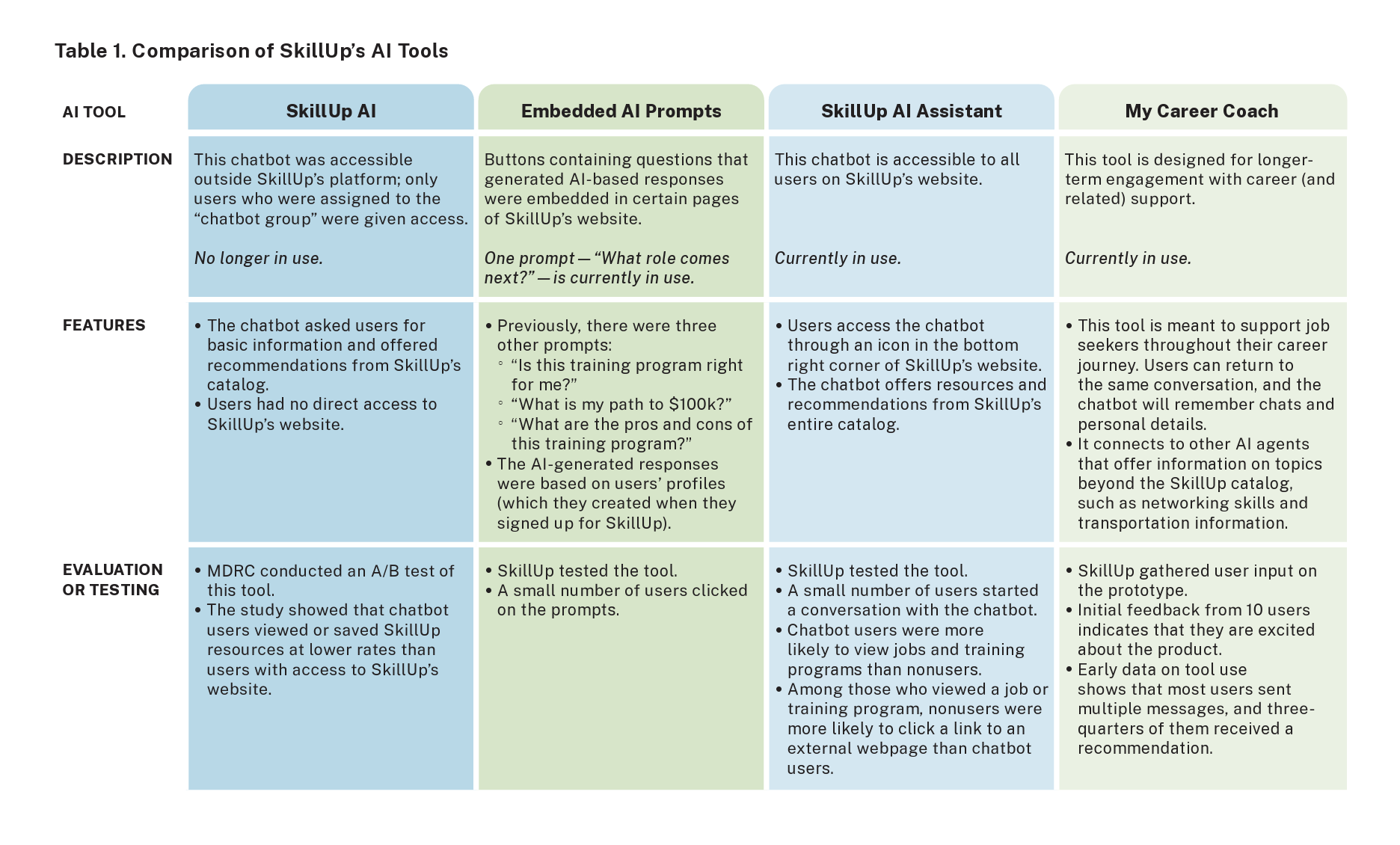
SkillUp initially decided to use AI to enhance its platform after seeing its potential to help users and hearing about interest from funders. While the decision to use AI tools did not directly stem from user feedback, SkillUp staff members felt AI could help users who were dealing with challenges like information overload (having too much information to process effectively), choice paralysis (difficulty making a decision when faced with too many options, like the many resources available in SkillUp’s catalog), a lack of confidence, skepticism of career resources and information provided (since some users come to SkillUp in a vulnerable state and may have had bad experiences with other workforce organizations), and ambiguity concerning how to use information to take action. Seeking to address these issues and understand how AI could help users, staff members at SkillUp and its external partners developed a series of AI-based tools that built on one another over time and took advantage of advancements in AI technology. (See Table 1 for an overview of the tools.) Staff members felt that the AI tools could help improve engagement on the platform and build users’ confidence, which they ultimately believe would improve users’ career-related outcomes. As the tools were being developed, staff members also conducted early testing with users and potential users of the platform to assess their interest in, sentiment toward, and anticipated usage of AI tools. Comments heard during testing informed the design of the tools.
Stage 1. The SkillUp AI Chatbot
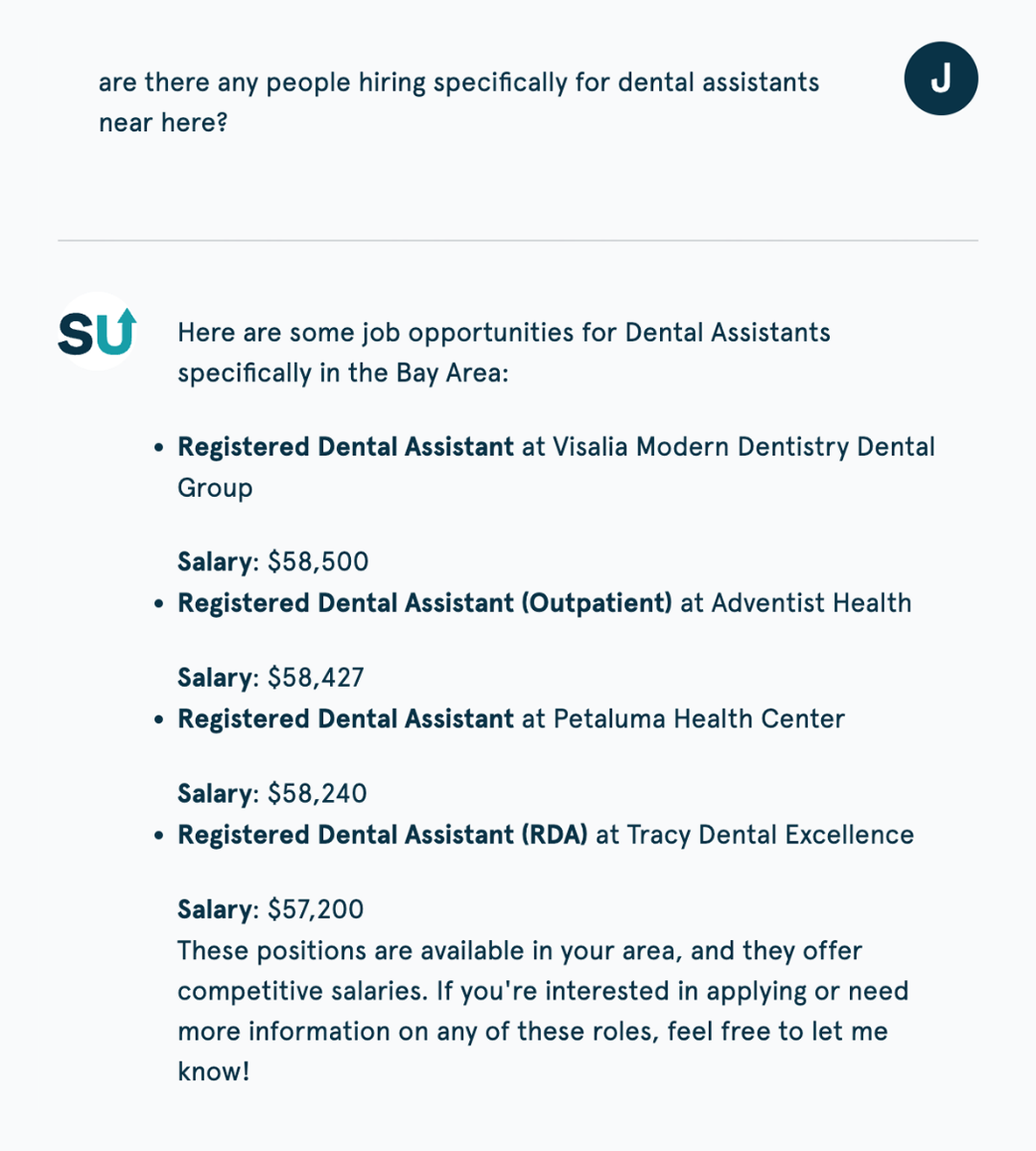
SkillUp’s first attempt to integrate an AI tool into its online platform was a standalone chatbot called SkillUp AI that it developed in 2024. The idea behind SkillUp AI was that it would help users sort through SkillUp’s vast catalog more easily and efficiently by providing personalized recommendations. Users were given access to an external website that contained only SkillUp AI; they were able to send and receive messages with the chatbot but were unable to browse SkillUp’s catalog on their own. The chatbot asked them about their work histories, skills, and interests, then suggested links to specific careers, training programs, and job listings in SkillUp’s catalog. Recommendations were shown as cards with links to opportunities, which users could open or save if they were interested. SkillUp deliberately limited the information the chatbot could draw on to its catalog, rather than unvetted publicly available sources. Figure 1 shows an example of a conversation with SkillUp AI.
SkillUp placed ads on Google and other platforms that directed job seekers to a sign-up page where they could create a SkillUp account and participate in MDRC’s A/B test of the chatbot. (A/B tests compare two different versions of something to see which version leads to better results.) Once they created an account, an algorithm developed by SkillUp staff members randomly assigned job seekers to a group that had access to SkillUp’s website as it existed before the development of SkillUp AI or to a group that had access to a website containing only SkillUp AI (the “chatbot group”). By comparing the outcomes of the two groups, MDRC was able to estimate the effects of SkillUp AI on users’ outcomes. The evaluation of SkillUp AI revealed that users in the chatbot group were less likely to view training and job opportunities in SkillUp’s catalog than users who could browse SkillUp’s catalog, and over one-half of the users in the chatbot group did not directly receive training and job recommendations.
Several factors explain why the chatbot led to fewer users viewing opportunities and receiving recommendations. First, users in the chatbot group could not see the SkillUp catalog unless the chatbot recommended a training program or job. For many, it is easier to click through a website than type messages to a chatbot. This may be why 16 percent of users never sent any messages to the chatbot. Additionally, the beginning of the conversation was largely scripted, meaning that users did not receive personalized responses until after they had sent several messages that provided their basic information—and many users stopped using the chatbot before they got to that point. In addition, SkillUp AI was limited: It was not always able to give users relevant information, and occasionally it malfunctioned or provided inaccurate results.⁷
Findings from the evaluation pointed to important lessons for SkillUp. First, users should not be required to use AI tools to access SkillUp’s catalog. Second, a faulty tool is worse than no tool at all. Some users probably lost trust in SkillUp after SkillUp AI hallucinated inaccurate results. In interviews with the MDRC team, SkillUp staff members also mentioned that the chatbot may have been too open-ended and that users might have benefited from more guidance on what they could ask the chatbot or what steps they could take with the guidance they had received. Finally, SkillUp AI was developed with external partners, which staff members felt limited their ability to be agile and fix problems quickly. These lessons shaped the design and implementation of later AI tools.
Stage 2. AI Prompts
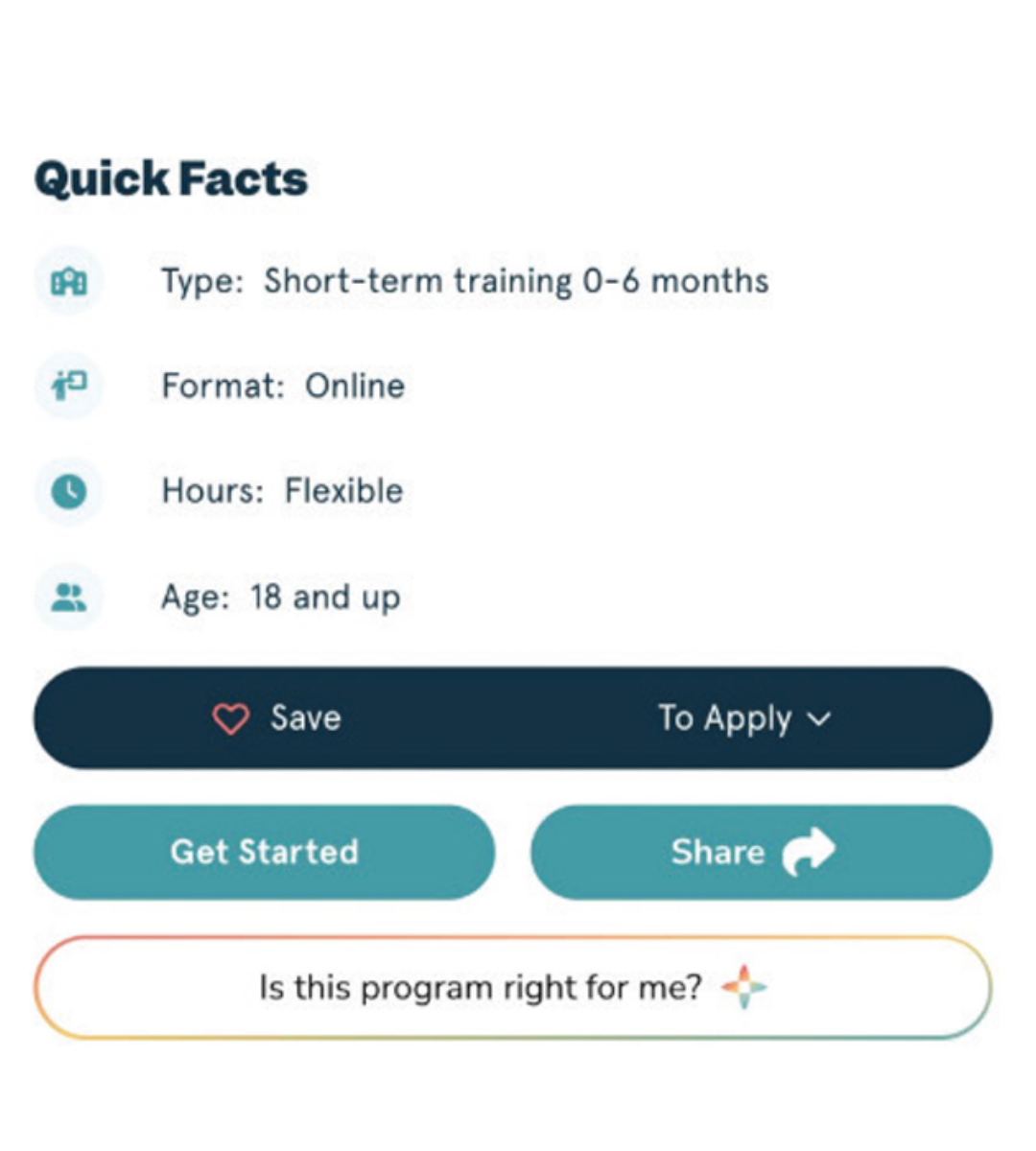
In late 2025, SkillUp pivoted its focus and embedded specific AI prompts directly into the SkillUp website. (The decision to change the type of tool and place it on SkillUp’s website was based on the findings from the SkillUp AI evaluation.) They were offered on pages where users needed to make decisions or act, based on the idea that a proactive nudge could prevent users from becoming stuck or disengaging (as they had with SkillUp AI). For example, when users opened a training program page, they saw a prompt asking, “Is this program right for me?” By clicking the prompt, users received an AI-driven response—based on the information in their profile—that could help them decide whether to pursue that specific program. (See Figure 2 for an example.)
SkillUp implemented three prompts, then tested which one users were most likely to click on and which one was most likely to lead users to do additional things on the website, like view a training program page or click a link to an external training program website. Overall, the prompts were used by a small share of SkillUp users (about 3,805 total users have interacted with an embedded prompt as of July 2026). SkillUp currently has one prompt—”What role comes next?”— on its career and training program pages (chosen based on current organization priorities and funding requirements). The other prompts, which all generated less engagement than SkillUp had anticipated, were discontinued.
In interviews, SkillUp staff members described mixed feelings about the usefulness of the AI prompts. Some saw them as a logical next step to SkillUp AI, which they felt was too open-ended to be useful for users. Others saw it as “clutter,” adding to an already potentially overwhelming user experience. Staff members also reported being unsure whether the AI prompts actually drove engagement or whether they were just used by people who were more engaged anyway.
Stage 3. The SkillUp AI Assistant Chatbot
After embedding the AI prompts in the site, SkillUp staff members developed a new chatbot called SkillUp AI Assistant, which appears as an icon in the lower right corner of SkillUp’s website and has fewer technological errors than SkillUp AI. (See Figure 3). SkillUp AI Assistant’s location on the website allows users to decide whether to interact with the tool, explore SkillUp’s catalog on their own, or do a combination of both.
Users adopted SkillUp AI Assistant more slowly than SkillUp expected: According to staff members, 1,452 users have started a conversation with SkillUp AI Assistant as of July 2026, which they estimate is less than 1 percent of users per month. To test the tool, SkillUp compared the activity of users who messaged the chatbot with the activity of users who did not, looking at actions like viewing or opening a link to a job or training program.⁸
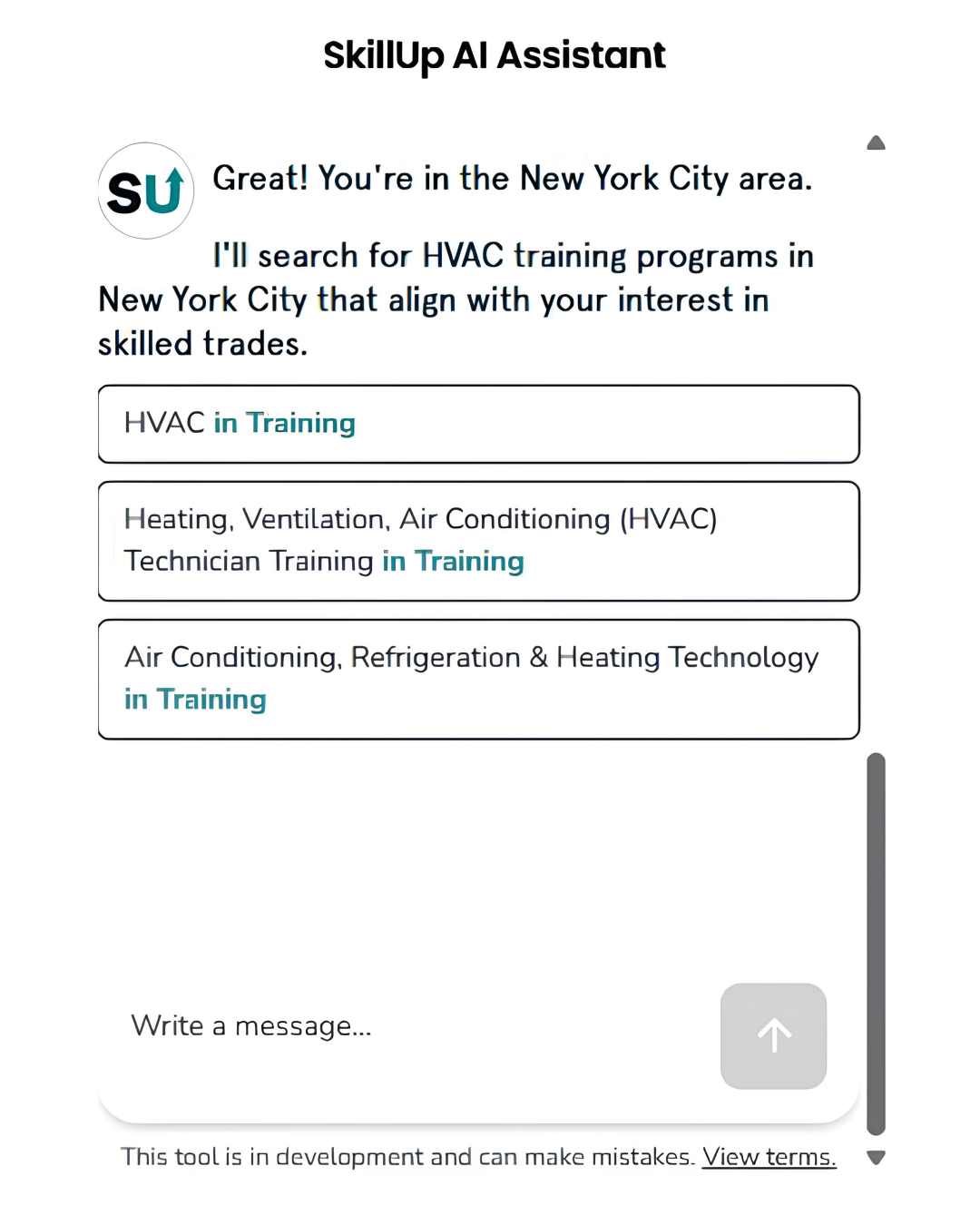
The findings of SkillUp’s test showed that users who interacted with SkillUp AI Assistant were two times more likely to view a job or training program than users who did not, suggesting the tool was associated with increased engagement with the SkillUp catalog. However, of the users who viewed a job or training program, those who did not use the chatbot were more likely to click a link to an external page where they could apply. In a survey administered by SkillUp, people who used the chatbot reported enrolling in training and obtaining jobs at lower rates than nonusers. The survey findings also suggest that users of SkillUp AI Assistant tended to be younger and earlier in their careers than other visitors to the site.
This internal testing suggests that SkillUp AI Assistant may have appealed the most to users who wanted to explore the training and job pages on SkillUp’s site but were not necessarily ready to do more. Users who knew exactly what they were looking for (and therefore would be more likely to view an external job or training web page) may not have felt they needed the chatbot, while users who were less sure of their career path might have found the chatbot more useful, as it could provide recommendations and guidance. It also could be the case that the SkillUp AI Assistant did not guide users to the kinds of training or jobs that they were interested in. Because SkillUp AI Assistant was not rigorously evaluated and the survey was only completed by a small number of users, it is difficult to understand the extent to which it led users to take action.
Stage 4. My Career Coach
As of summer 2026, SkillUp has developed a new, more comprehensive AI tool (called My Career Coach) that directly addresses the challenges the staff identified with the prior tools and takes advantage of advancements in AI technology. Unlike the previous tools, which offered one-time information or recommendations, My Career Coach is designed to provide ongoing support over a user’s entire career journey. It remembers conversations—meaning that users can come back to the same chat at different points in their job search and career. To ease users’ burden, My Career Coach allows both text and voice conversations. (The latter is an attempt to further reduce the inconvenience of having to type out multiple messages, as with SkillUp AI.) It also builds “About Me” profiles that capture users’ information over time, meaning they do not need to provide personal details with every new question (as they did before). Instead of pulling only from SkillUp’s catalog, My Career Coach draws on other AI agents with specialized information (for example, AI agents that can help them build networking skills or provide transportation information) that have been developed by SkillUp’s partners. It also assists users with tasks like writing and editing resumes and cover letters, though some staff members questioned whether producing AI-generated job application materials should be a primary focus of the tool. (Previous tools could only point users to resources on these tasks.) My Career Coach has some similar capabilities as more widely available AI models (like ChatGPT or Gemini), but by limiting My Career Coach to resources that are curated by SkillUp and its partners, SkillUp aims for it to offer more helpful and already-vetted information.
Before the launch of My Career Coach, SkillUp staff members conducted initial user testing to shape its design. Ten users who tested an early version of My Career Coach said they were interested in using it; they valued the personalization, direction, and structure it offered; and they appreciated the ability to come back to the same conversation as many times as they needed.
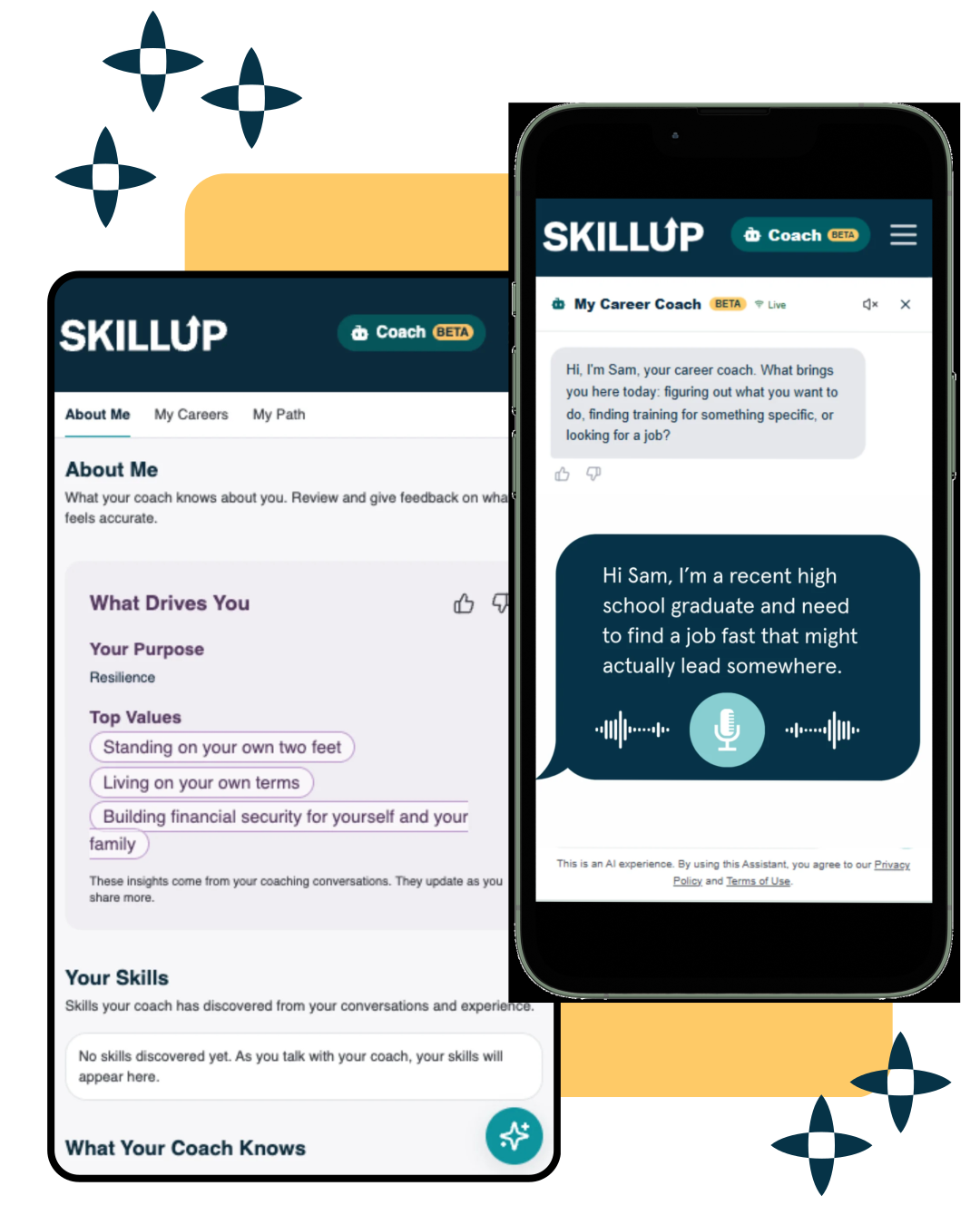
SkillUp pilot tested My Career Coach in July 2026, making it available to a selection of its users. (Figure 4 shows an example conversation.) Early data on tool usage for the first 1,043 users (analyzed by MDRC) show that, on average, users sent and received about 7 messages—with some users sending over 150 messages—and spent an average of 11 minutes using My Career Coach. (Data analyzed by SkillUp that covers the same time period showed that nonusers of the chatbot spent less time—only 3 minutes—on SkillUp’s main platform.) These conversations resulted in 75 percent of early My Career Coach users receiving a recommendation from the chatbot, 37 percent viewing a catalog item on SkillUp’s website, and 21 percent clicking on an external link where they could apply to a job or training program.
Overall, these trends show that My Career Coach has the potential to be a useful tool for career navigation. At this early stage, however, it is unclear if these usage trends will change as more users engage with the tool and SkillUp continues to iterate on the Figure 4. My Career Coach tool’s features. Further, not enough time has passed to know how many users will return to have additional conversations with the chatbot (as SkillUp intended). As the rollout of My Career Coach continues, SkillUp will continue exploring how people use the tool, where they experience challenges, and whether it leads to better employment outcomes (potentially through a second rigorous evaluation).
Lessons on Adopting and Using AI Tools
The rapid growth of AI in the past few years has lowered barriers to accessing and developing new tools, enabling organizations to incorporate AI into their internal day-to-day work and the services they provide. While these tools may offer significant value to organizations and individuals, without careful planning, design, and rollout, they may fail to help—and potentially even harm—users.
SkillUp staff members are grappling with these considerations, along with broader questions about what the expansion of AI-related technology means for the population they serve. AI can simultaneously be seen as an opportunity and a threat. It has the potential to improve career navigation services and make them available to individuals who do not otherwise have access to them, which could improve their employment outcomes. It could also reduce equity gaps in terms of which people are able to access services.⁹ At the same time, many experts believe that AI is restructuring how work is organized, which tasks are bundled into jobs, and which skills lead to upward economic mobility.¹⁰ The evidence is still emerging on the extent to which AI may replace jobs.¹¹ It is clear, though, that programs and organizations trying to help job seekers will need to navigate rapidly changing industries and different opportunities for their participants. For example, there is evidence suggesting that employment has declined in entry-level jobs that are at risk of being automated by AI, but not in entry-level jobs that can be augmented by AI.¹²
Within this context, SkillUp’s AI journey offers lessons to other organizations that are looking to integrate AI tools into career navigation services. These lessons are based on findings from the SkillUp AI evaluation (the only external, rigorous study of SkillUp’s AI tools to date), the MDRC team’s evidence review of the use of AI in career navigation, and interviews with SkillUp staff members.
- UNRELIABLE AI TOOLS MAY BE WORSE THAN NO AI TOOLS. MDRC’s evaluation of SkillUp AI showed that interaction with a flawed chatbot led to reduced engagement with SkillUp’s catalog. This finding suggests that it can take time to develop useful AI tools and that those tools need to be evaluated to ensure they are operating as intended. If they are not working well, they should be discontinued (as was done by SkillUp).
- EARLY ITERATION OF AI TOOLS SHOULD BE VIEWED AS A LEARNING EXPERIENCE. Researchers have found that new technologies often follow a “productivity J-curve”: A technology is often underwhelming (in terms of productivity) at the beginning and its full potential is only realized later.¹³ The evaluation of SkillUp AI, the first of SkillUp’s tools, led to unfavorable results, consistent with this J-curve. However, SkillUp staff members felt that the evaluation was critical to the development of the later AI tools, suggesting that it was a useful learning experience that helped them better determine what would benefit users. Internal analyses of the later AI tools also showed they had more potential to help users.
- USERS SHOULD HAVE THE OPTION TO USE AI TOOLS OR EXPLORE RESOURCES AND INFORMATION ON THEIR OWN. Information should not only be accessible through AI tools. Results from the SkillUp AI evaluation made this lesson clear—users were more likely to click through the website than message the chatbot—as does the slow adoption of later AI tools by SkillUp users. Some users may prefer to find information on their own, while others may want input from an AI tool on how to proceed.
- AI TOOLS MAY WORK BEST WHEN OFFERED IN COMBINATION WITH HUMAN SUPPORT. Research suggests that AI tools should be designed to complement human services, not replace them.¹⁴ SkillUp does not currently prioritize offering human-led services on its platform, other than offering text-based career coaching (through a partnership with a nonprofit organization called Empower Work) and virtual group career coaching sessions. SkillUp AI Assistant currently recommends these career coaching options to users when relevant, and My Career Coach will begin offering them in late 2026. In the longer term, SkillUp has enabled My Career Coach to draw on information (in the form of notes or transcripts) from the conversations users have with human coaches so that the tool maintains the context, memory, and next steps from the conversations.
- AI TOOLS SHOULD BE DESIGNED TO BUILD USER SKILLS AND ABILITIES, NOT JUST HELP THEM COMPLETE TASKS. There is some early evidence suggesting that when AI is used for a task, it can result in less learning and engagement with that task.¹⁵ Organizations offering career navigation services can combat this issue by offering AI tools that help users write a resume or cover letter but do not do it for them. AI tools could be used to review or update resumes and cover letters, with a clear note that they should be reviewed by humans before they are used. Otherwise, job seekers may not know what information they have submitted or how they can update their materials in the future.
- GUARDRAILS ARE NECESSARY TO PROTECT PARTICIPANT PRIVACY AND WELL-BEING. When users share personal information with AI tools, organizations must ensure that this information is protected and that a tool’s responses to users are appropriate. In the case of My Career Coach, which provides career and related support (like financial guidance or childcare referrals), users can share information when they are in a crisis, and the wrong response from the chatbot—for example, if it provides inaccurate or inappropriate guidance, or misses signs that the user needs urgent help—could be harmful to the user. SkillUp has designed My Career Coach to constantly evaluate its own responses—aiming for high response accuracy when it detects that an individual is in “crisis mode” —and is considering having a human coach schedule a session with users when needed.¹⁶
- ORGANIZATIONS SHOULD BE TRANSPARENT ABOUT WHEN THEY ARE USING AI AND WHICH AI TOOLS ARE STILL BEING DEVELOPED. AI can offer incorrect, fabricated, or misleading information at times. If organizations are not transparent about when tools are still being developed and are more likely to malfunction or give incorrect information, users may trust the tools less. SkillUp embeds messages like “This tool is in development and can make mistakes” within its AI tools.
Looking Forward
SkillUp’s AI journey demonstrates the iterative process that is required to integrate AI tools into career navigation services: Organizations build tools, test them, and use what they learn to improve them. SkillUp AI was developed and then rigorously evaluated by MDRC. The findings from that study influenced the design choices for the next set of AI tools—the embedded AI prompts and SkillUp AI Assistant. SkillUp conducted internal tests of those two tools (tracking and comparing the activity of people who used AI with those who did not, and conducting small surveys). Through these tests, the SkillUp team learned—among other things—that AI tool usage was not as high as expected and users may need to be able to get multiple types of information or benefits to continue engaging with the tools. These results informed the development of My Career Coach, which SkillUp plans to test in the future.
This emphasis on continued improvement has important implications for how AI tools should be evaluated. With prototypes constantly changing and AI models and public perceptions of AI rapidly evolving, traditional rigorous evaluations like randomized controlled trials may be too slow to be useful for early-stage tool development. SkillUp (and other organizations) would more likely benefit from flexible, rapid-cycle tests—short tests designed to quickly learn what is working and adjust accordingly—that allow for real-time learning and decision-making.
This was the approach used in the SkillUp AI evaluation: MDRC and SkillUp monitored the use of the chatbot and its short-term outcomes on a regular basis. When it was clear the chatbot was not improving users’ outcomes, the evaluation was paused, and the results were analyzed to pull out lessons for the next stage of tool development. With the ongoing rollout of My Career Coach, SkillUp has the opportunity to apply this approach again. By using rigorous, rapid feedback loops, SkillUp can assess whether the more advanced AI tool works as intended, leads to high levels of engagement, and helps job seekers obtain better employment opportunities. To benefit job seekers most, organizations will need to pair technological innovation—as AI continues to evolve—with this type of ongoing learning and a deep understanding of job seeker needs.
Notes and References
- For an overview of the evidence on career coaching, see Joseph Fuller, Kerry McKittrick, Sherry Seibel, James Wilson, Vasundhara Dash, and Alexandra Epstein, Unlocking Economic Prosperity: Career Navigation in a Time of Rapid Change (Cambridge: Harvard Kennedy School, 2023).
- The study—which was conducted by CareerVillage—involved a survey of users. Because individuals could decide whether to interact with Coach, the study does not provide causal evidence of the tool’s effectiveness. It is not known how satisfied the users would have been if they had only interacted with CareerVillage’s non-AI offerings. See Sarah Shaw and Abigail Lupi, Evaluating Career Development Outcomes for Coach, a GenAI Project by CareerVillage.org (CareerVillage, 2024).
- A Pew Research survey in 2026 showed that 49 percent of American adults had used an AI chatbot, yet 31 percent felt AI would have a negative effect on them personally, and 40 percent felt AI would have a negative effect on society. See Jeffrey Gottfried, William Bishop, Monica Anderson, Michelle Faverio, Eugenie Park, and Colleen McClain, Americans and AI Artificial Intelligence 2026: Chatbots, Smart Devices and Views on Impact (Pew Research Center, 2026).
- Leah Eggers, Tracey Everett, and Tiffany Hsieh, Get Better Results for Jobseekers with Generative AI: A How-To Guide for Career Coaches (Jobs for the Future, 2025).
- Shaw and Lupi (2024).
- Eggers, Everett, and Hsieh (2025).
- See additional information and findings in Bennet Otten, Kelsey Schaberg, and Jason Cheng, Using AI To Help Job Seekers: Lessons From SkillUp AI (MDRC, 2025).
- Since users were not randomly assigned to use or not use SkillUp AI Assistant but rather were able to decide whether to use it, it is likely that the users who engaged with SkillUp AI Assistant are different than the users who did not in ways that may relate to their activity and outcomes.
- Joseph B. Fuller and Amanda Cage, “In the Age of AI, We Need A System of Career Navigation for All” (website: https://thehill.com/opinion/4404065-in-the-age-of-ai-we-need-a-system-of-careernavigation-for-all/, 2024).
- Anders Humlum and Emilie Vestergaard, “Still Waters, Rapid Currents: Early Labor Market Transformation under Generative AI,” NBER Working Paper 33777 (National Bureau of Economic Research, 2025).
- Bharat Chandar, AI and Labor Markets: What We Know and Don’t Know (Stanford Digital Economy Lab, 2025).
- Eric Brynjolfsson, Bharat Chandar, and Ruyu Chen, Canaries in the Coal Mine? Six Facts about the Recent Employment Effects of Artificial Intelligence (Stanford Digital Economy Lab, 2025).
- Erik Brynjolfsson, Daniel Rock, and Chad Syverson, “The Productivity J-Curve: How Intangibles Complement General Purpose Technologies,” American Economic Journal: Macroeconomics 13, 1 (2021): 333–372.
- See, for example, Isabella Loaiza and Roberto Rigobon, “The EPOCH of AI: Human-Machine Complementarities at Work” (MIT Sloan School of Management, 2025) and Jonathan Passmore, Bergsveinn Olafsson, and David Tee, “A Systematic Literature Review of Artificial Intelligence (AI) in Coaching: Insights for Future Research and Product Development,” Journal of Work-Applied Management 18, 1 (2026): 110–129.
- In one study, 54 participants were randomly assigned to either a group in which they wrote an essay on their own, a group in which they could use any website to help them write an essay, or a group in which they used ChatGPT (an AI chatbot) to write an essay. The study found that the people who used ChatGPT exhibited less brain activity (a measure of cognitive engagement and cognitive load) while writing the essay, were less able to remember what they had written afterward, and felt less ownership over their writing. See Nataliya Kosmyna, Eugene Hauptmann, Ye Tong Yuan, Jessica Situ, Xian-Hao Liao, Ashly Vivian Beresnitzky, Iris Braunstein, and Pattie Maes, “Your Brain on ChatGPT: Accumulation of Cognitive Debt when Using an AI Assistant for Essay Writing Task,” arXiv preprint arXiv:2506.08872 (2025).
- SkillUp users navigate SkillUp’s catalogs and website on their own, without involvement from a SkillUp staff member. AI could be a particularly beneficial addition to SkillUp’s website, as the AI tools are not intended to replace already existing human support. However, SkillUp has not offered comprehensive career support before, including counseling-like services; My Career Coach will be offering this type of support for the first time. As leaders of career navigation organizations consider how to incorporate AI into their services, it is important to understand how the technology may fundamentally shift what their organizations offer and whether additional support is necessary.
Acknowledgments
We would like to thank the staff members from SkillUp who collaborated with us on this project, provided resources and data, and thoughtfully contributed to the development of this brief. In particular, we thank Haleigh Boulanger, Desiree Jewell, Steve Lee, Pam Portman, and Elissa Salas. We also thank our MDRC colleagues Richard Hendra, who helped craft the vision for the brief and provided overall guidance and support; Bennett Otten, who reviewed the draft and provided insightful feedback on lessons from the SkillUp AI study; Mary Bambino, who managed the project budget and timeline; Jillian Verrillo, who edited this brief; and Carolyn Thomas, who prepared it for publication.
The research reported here was supported by the Gates Foundation through a grant to SkillUp Coalition.
The following organizations support the dissemination of MDRC publications and our efforts to communicate with policymakers, practitioners, and others: Arnold Ventures, Ascendium Education Group, Yield Giving/MacKenzie Scott, and earnings from the MDRC Endowment. Contributors to the MDRC Endowment include Alcoa Foundation, The Ambrose Monell Foundation, Anheuser-Busch Foundation, Bristol-Myers Squibb Foundation, Charles Stewart Mott Foundation, Ford Foundation, The George Gund Foundation, The Grable Foundation, The Lizabeth and Frank Newman Charitable Foundation, The New York Times Company Foundation, Jan Nicholson, Paul H. O’Neill Charitable Foundation, John S. Reed, Sandler Foundation, and The Stupski Family Fund, as well as other individual contributors.
The findings and conclusions in this report do not necessarily represent the official positions or policies of the funders.
For information about MDRC and copies of our publications, see our website: www.mdrc.org.
Copyright © 2026 by MDRC®. All rights reserved.