
For many people, career navigation starts with a practical point of entry: What job can I get? It's a perfectly reasonable question. But in a labor market disrupted by technological advancements that still tends to demand a degree — even though skills can be obtained through various routes — a job listing alone isn't enough to sustain a person’s energy for their career journey.
What keeps someone showing up for their six-month training program when hurdles pop up? How can a worker who gets laid off resist the pull of the first available option and instead pivot toward something better? What makes someone return to career exploration after life gets in the way? For STARs (Skilled Through Alternative Routes), who often face immediate pressure to forego their purpose in favor of a paycheck, these aren’t merely hypothetical questions. Often, these reflect the reality of their career navigation journey with high stakes at every decision point.
The answer, increasingly supported by research, is purpose.
Defining Purpose
We don’t mean “purpose” as the abstract and often-elusive "calling" that productivity culture tells people to find. Rather, we think of purpose as a practical and buildable cognitive resource. Think of it as a career navigation compass, something that helps people allocate their limited time and energy toward goals that align with who they are and keeps them going even when the path gets hard.
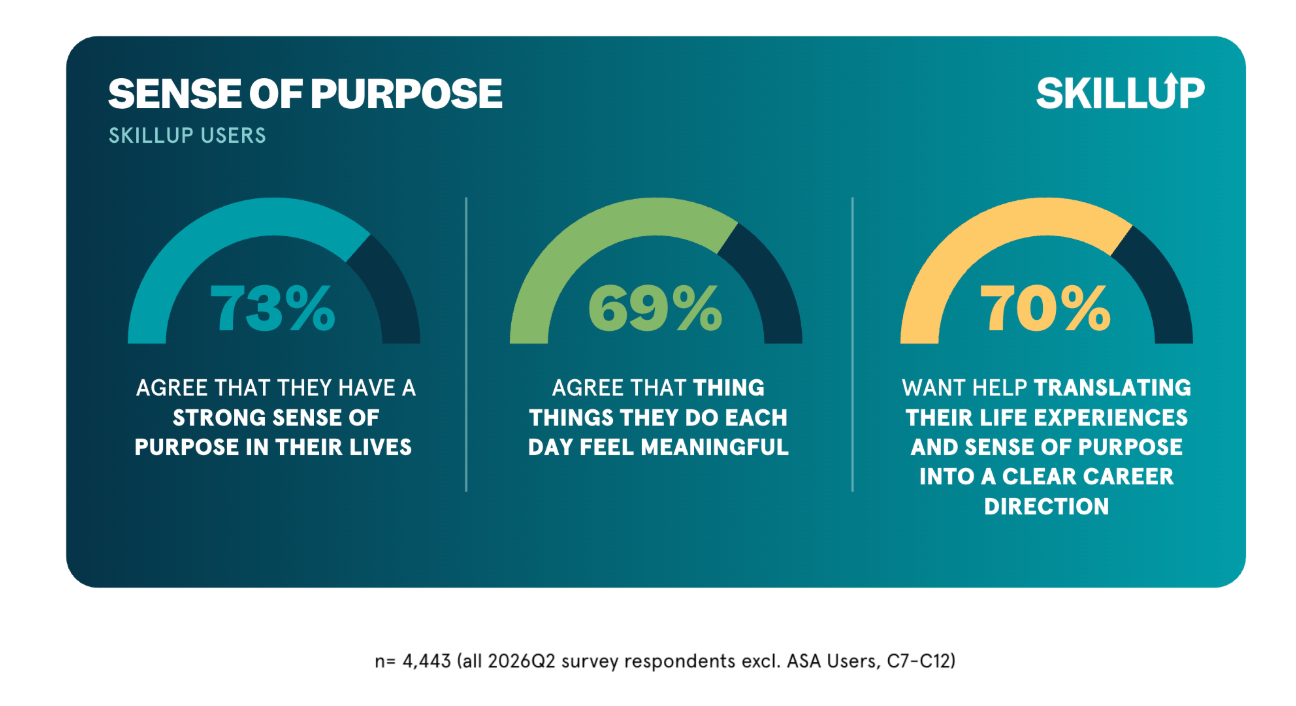
Our SkillUp Pulse Survey validates that this guiding resource is present in the people we serve: 73% of SkillUp users agree they have a strong sense of purpose in their lives and 69% say they do things each day that feel meaningful. Yet 70% also say they want help translating that existing sense of purpose into clearer career navigation choices. So, SkillUp started thinking about how we can build the infrastructure to connect purpose to action.
Research confirms that purpose is an independent predictor of “grit” — the persistence required to follow through with training programs rather than abandon them for immediate but lower-value job opportunities. Purpose functions as a shock absorber, helping workers maintain their momentum through hurdles and everyday stressors that would otherwise cause job seekers to abandon their trajectory. Purpose pays off financially, too. A long-term study tracking thousands of adults over nearly a decade found that those with a stronger sense of purpose entered with higher income and net worth, and pulled further ahead over time, independent of baseline demographics.
Supporting Resilient Career Navigation with Purpose
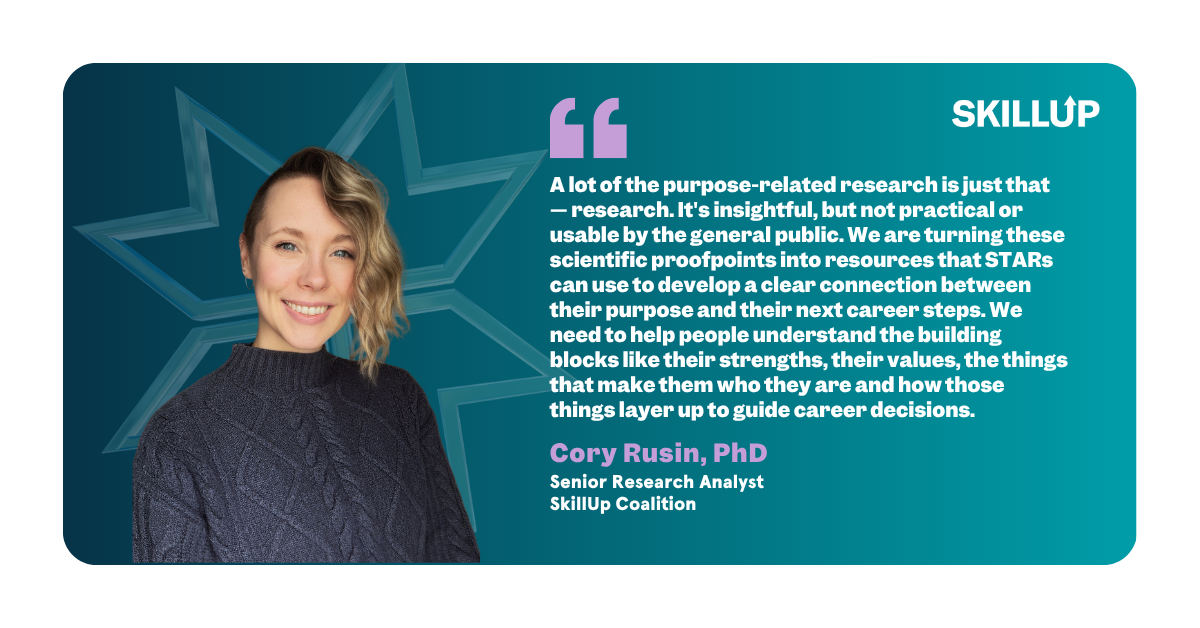
"A lot of the purpose-related research is just that — research," says Cory Rusin, PhD, Senior Research Analyst at SkillUp Coalition. "It's insightful, but not practical or usable by the general public. We are turning these scientific proofpoints into resources that STARs can use to develop a clear connection between their purpose and their next career steps. We need to help people understand the building blocks like their strengths, their values, the things that make them who they are and how those things layer up to guide career decisions."
The framing is important, especially when workers need to navigate disruptions. For example, if someone’s career path disappears, whether due to automation, a layoff or a market shift, workers with a clear internal compass are better equipped to re-engage with goal-setting. Purpose provides what researchers call "identity capital” — a stable sense of self that persists even when external job roles vanish. For STARs, who tend to navigate more instability with fewer institutional supports, that kind of internal infrastructure is critical.
Helping STARs Act on Their Purpose
At SkillUp, we’ve begun layering this research and guidance into our platform to help STARs find meaningful careers. In addition to offering purpose-driven workshops with nXu, we have woven early purpose-related capabilities into our AI supports to point users toward their values, strengths and drivers to deliver even better personalized career and training guidance. Long term, our vision includes developing structured pathways that help users move from purpose exploration to engagement to articulation, progressively building clarity about who they are and where they want to go. Developing purpose isn't a one-time exercise. It's an ongoing resource that gives job seekers a reason to return to career development even after they've landed a job.
“Purpose development doesn't stop when employment begins,” says Rusin. “SkillUp has spent years building rigorously vetted training, career and job catalogs for our platform. Now we are adding scaffolding that enables STARs to persist, pivot and connect their purpose to aligned career decisions.”
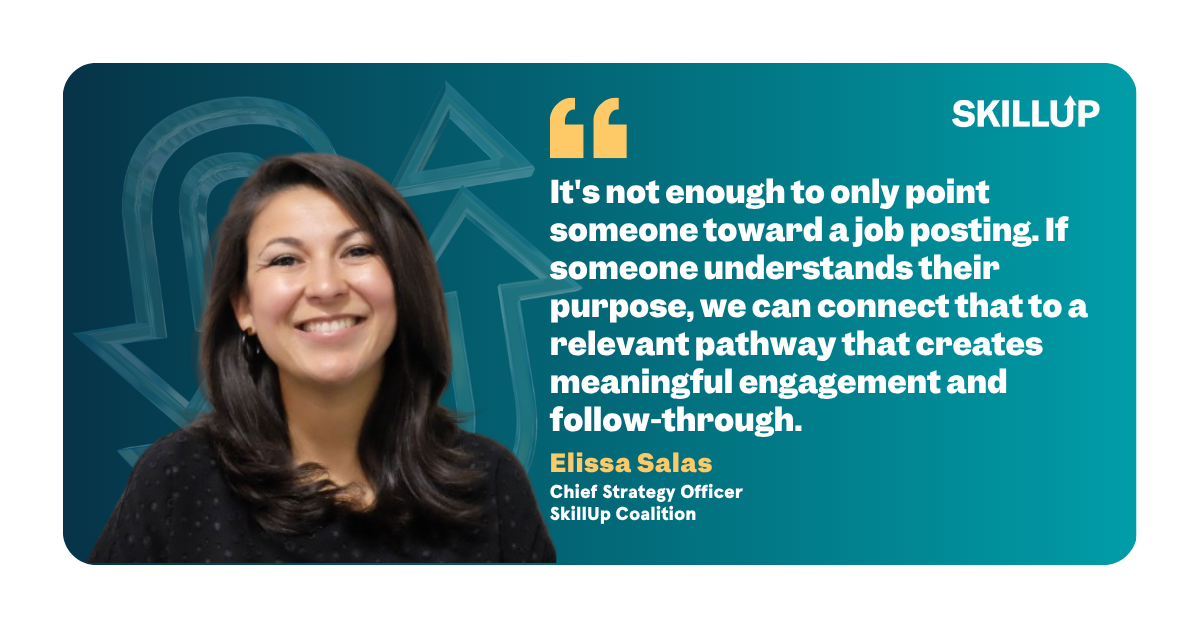
Chief Strategy Officer, Elissa Salas also notes, "It's not enough to only point someone toward a job posting. If someone understands their purpose, we can connect that to a relevant pathway that creates meaningful engagement and follow-through."
With 70% of our surveyed users stating they want help connecting their lived experience and sense of purpose to clearer career navigation, we know our focus on purpose-driven career resources makes a difference. This additional infrastructure makes everything else SkillUp offers — including our jobs and training catalogs, career resources and AI tools — increasingly useful for the workers who need it most. If your organization focuses on elevating economic mobility for STARs and wants to support our work toward those stronger outcomes, we’d love to hear from you. Connect with us at https://skillup.org/partners.