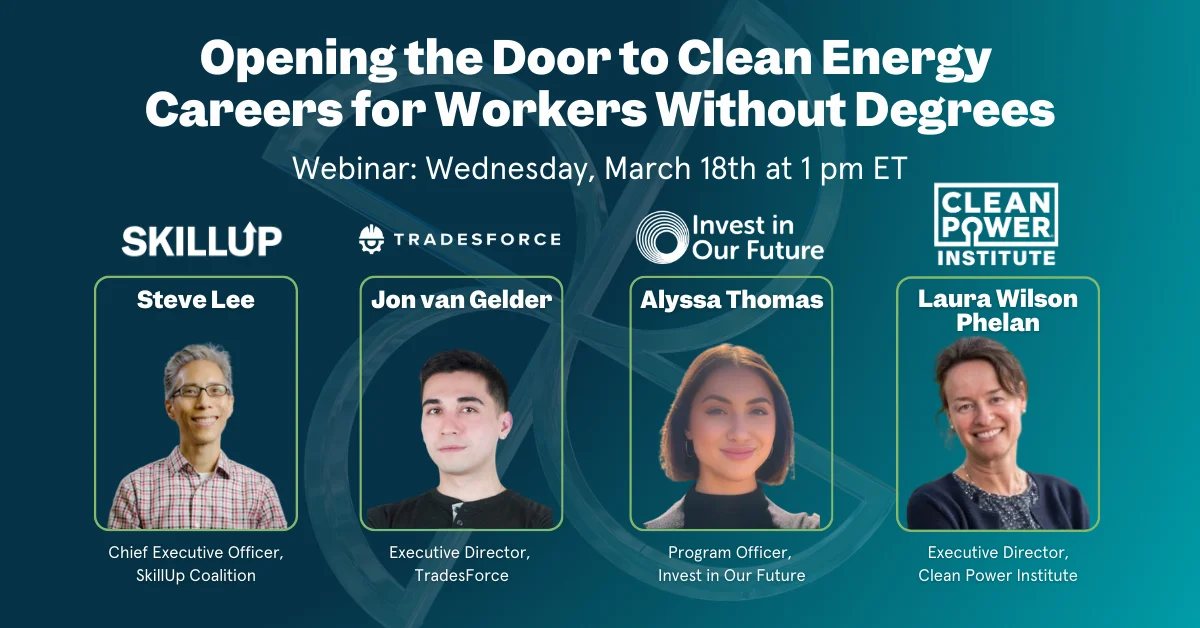
The clean energy revolution won't build itself. Driven by historic electricity demands from new data centers and the urgent need for grid reliability, the market is dictating an aggressive, immediate infrastructure build-out. However, we face a massive skilled trades shortage that threatens deployment. To meet this demand, we must aggressively open the door to inclusive pathways for workers skilled through alternative routes (STARs). At SkillUp, we are uniting philanthropy, workforce innovators, and industry to dismantle cultural stigmas, abandon failing training models, and scale high-paying, AI-resilient career pathways for workers without degrees.
Funding Intermediaries and Industry Alignment
The era of funding siloed, "go at it alone" training programs must end. As Laura Wilson Phelan from the Clean Power Institute warns, too often students invest in programs only to "graduate and they're not necessarily more employable... because their program was never aligned to actually the jobs that are available in the marketplace". Philanthropy must pivot to fund intermediaries that connect public education with actual employer needs. As Alyssa Thomas from Invest in Our Future notes, we need seed funding to motivate the market, and "I encourage philanthropy to not think about industry as your opposition but as your partner in building the type of workforce that you want to have".
Investing in AI-Resilient, Life-Changing Careers
If funders are looking to solve for the economic disruption of AI, clean energy construction is the data-driven answer. As Alyssa Thomas states, "You're not about to go train a model to go install solar on someone's roof like that just simply can't happen". More importantly, these are worker-first jobs offering immediate economic mobility. A worker can step onto a job site "with zero training as a wind technician in a rural area where cost of living is low at a minimum of $59,000". By investing in these pathways, partners are driving localized economic booms—sometimes yielding a "100% increase in household... median income" in rural project areas, delivering truly life-changing wages while helping workers avoid crippling student debt.
Cultural Activation and Breaking Stigmas
The demand for these jobs among workers is surprisingly high, but the pipeline is clogged by a "ton of cultural stigma around jobs if you're not already in the trades". Jon van Gelder shared data that shows that workers are primarily driven by the prospect of "high pay... and avoiding student debt" rather than the climate narrative alone. Through innovative cultural activations—such as integrating with major music artists to reach diverse, working-class audiences—Tradesforce is actively shifting the narrative. These pilot events have achieved massive engagement, boasting 10% conversion rates from concert sign-ups directly into our union and industry talent pipelines.
How SkillUp Can Help
SkillUp serves as the critical connective tissue between latent worker demand, philanthropic capital, and urgent industry need. We provide the modern digital infrastructure required to overcome the "digital barrier" that historically keeps diverse talent out of the trades. Our platform data proves the demand is there: Skilled Trades training engagement is up to 41% among our users. We invite foundations, C3 organizations, and industry leaders to partner with us to fund inclusive pathways, align curricula to real jobs, and scale the "last mile" of job placement. Connect with our partnership team today to explore how your organization can co-invest in the workforce of the future.
Scaling Career Opportunities Regionally
The clean energy transition is a hyper-localized effort requiring a localized talent pool to avoid the high costs of a traveling workforce. We are scaling regional pathways to connect local workers directly with vetted, localized job training programs and employing companies. Partners can view our public-facing ecosystem by visiting skillup.org/tradesforce.
Online Career Support
Through the SkillUp and Trades Force platform, our national support services handle the critical top-of-funnel work—intake, cultural awareness, and career navigation—required to seamlessly funnel interested workers into specific union and industry opportunities without them getting lost in the noise.
Frequently Asked Questions (FAQ)
Why should philanthropy prioritize clean energy workforce development right now?
The market is dictating an aggressive build-out due to historic electricity load growth, which is projected to increase 35% to 50% by 2040. Investing in the clean energy workforce is not just a climate play; it is a direct investment in economic equity and AI-resilient careers that provide immediate, life-changing wages for workers without a four-year degree.
How can funders avoid investing in ineffective training programs?
Philanthropy must fund intermediaries that actively collaborate with the clean energy industry to create standardized, industry-vetted micro-credentials. We must stop funding isolated "go at it alone" programs that take students' time and money but do not align with actual marketplace demands or lead to higher employability.
What is the biggest barrier for workers entering this sector?
There is a dual barrier: deep cultural stigma around skilled trades, and a massive "digital barrier" making it incredibly difficult for individuals outside the trades to find legitimate training and apply for jobs. SkillUp and our partners actively dismantle these barriers through targeted cultural organizing and a streamlined, worker-first digital platform.


