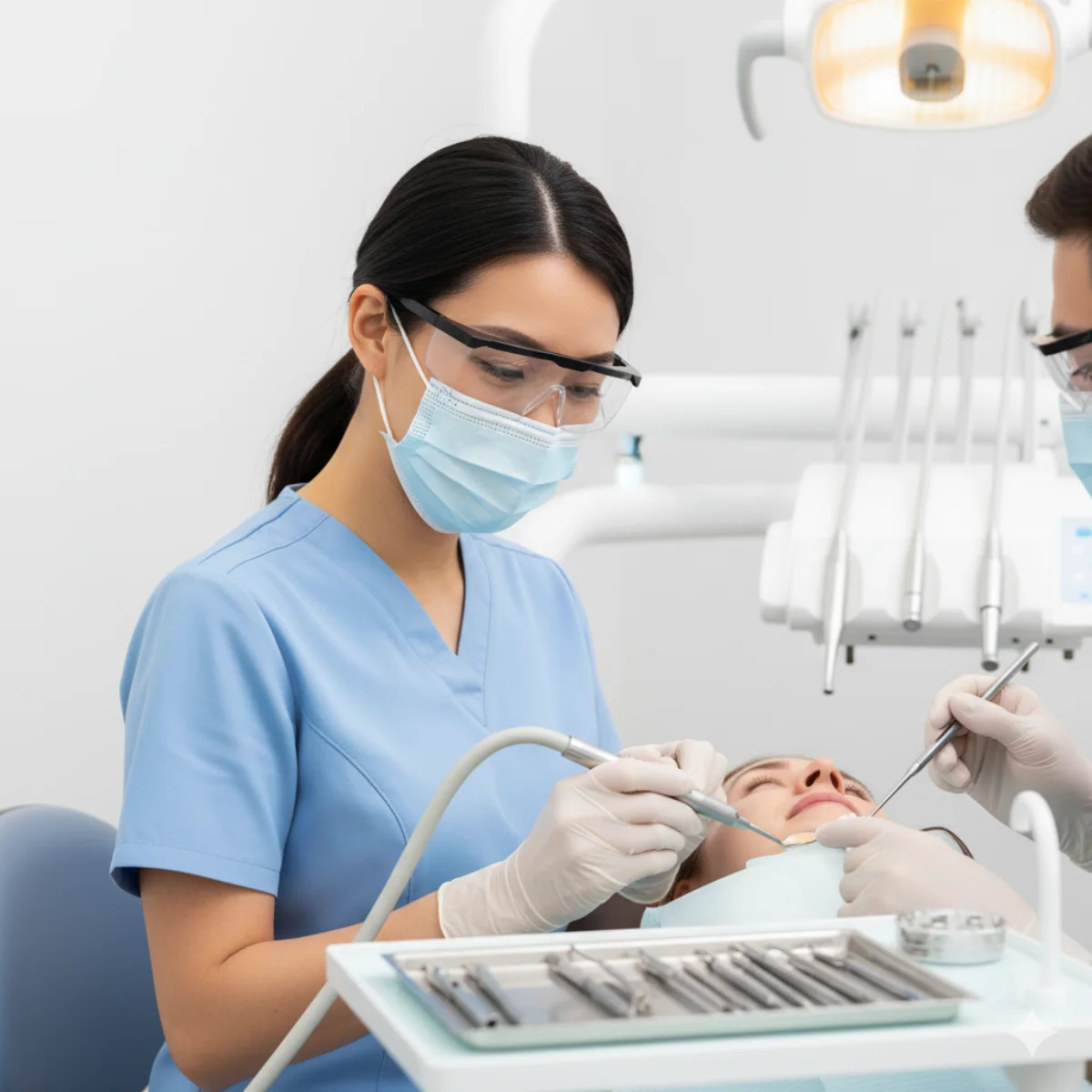
Most healthcare jobs ask for years of school first. Dental assisting doesn't.
In most states, you can start by training on the job, then earn a certification that bumps your pay. It's one of the quickest ways into a healthcare career, and a solid one, with room to grow.
This guide answers what the work is, how long it takes, whether you need school or a certification, what it pays, and where it can lead.
What Does a Dental Assistant Do?
Dental assistants keep a practice running. You'll work chairside next to the dentist and pass instruments, keep the area dry and clear, and help patients stay comfortable through a procedure.
The job mixes clinical and office work. One hour you're prepping a tray and taking X-rays; the next, you're updating records, scheduling, or walking a nervous patient through what's coming.
Almost all dental assistants work in dentists' offices, usually full-time, with some clinics and group practices hiring too.
Because the role touches nearly every part of a practice, it's a strong first rung in healthcare, the kind of job that teaches you the field from the inside.
It's people-first and detail-heavy, so it suits someone who stays calm under pressure and is good with their hands and with patients. Curious whether it fits how you work? SkillUp's Work Styles Quiz takes about five minutes, and it flags dental assisting as a match for the Social and Conventional styles.
How Long Does It Take To Become a Dental Assistant?
Faster than almost any other healthcare role. The timeline depends on your route.
A formal program, the kind offered at community colleges and trade schools, usually takes nine to twelve months for a certificate or diploma. Costs range from a few thousand dollars at a community college to more at a private school, and many programs qualify for financial aid.
The on-the-job route can be quicker still. In states that allow it, you can be hired as an entry-level assistant and start learning right away, then pick up certification later. On that route, you're earning from your first shift instead of paying tuition to learn.
Either way, you can often be working in under a year, sometimes within a few months. If you already have healthcare or customer-service experience, you may move even faster.
Do You Have To Go to School To Become a Dental Assistant?
In most states, you don't have to. Roughly 46 states let you train entirely on the job and learn chairside under a licensed dentist.
A formal program still has its perks. It can speed up certification, teach radiology and infection control up front, and help you stand out to employers in a crowded market.
A program usually covers chairside skills, dental materials, radiology, and office basics like records and billing, so you arrive job-ready.
If you go the program route, compare dental assisting training on SkillUp by cost, length, and format. The catalog leans toward short, low-cost or free options that lead to livable-wage work, so you're not taking on debt to get started.
A high school diploma or GED covers the baseline either way, and many offices want a current CPR certification, too.
Do You Need Certification To Be a Dental Assistant?
It depends on your state and what you want to do. A handful of states call for a license or certification to work at all; most don't. But certain tasks are gated almost everywhere.
Taking X-rays is the big one. Most states require a radiology certification before you can operate the equipment. Expanded duties like coronal polishing or applying sealants usually call for extra training.
The credential that travels best is the DANB Certified Dental Assistant (CDA). It's recognized nationwide and covers general chairside assisting, radiation safety, and infection control.
The CDA is three separate component exams, so you can tackle them one at a time as you're ready.
DANB CDA
What It Covers: General chairside, radiation safety, and infection control
When You Need It: Recognized everywhere; mandatory in a few states
Radiology (DANB RHS)
What It Covers: Taking dental X-rays safely
When You Need It: Needed in most states before you can take X-rays
Expanded Functions (State EFDA or RDA)
What It Covers: Extra duties like coronal polishing and sealants
When You Need It: When you want more responsibility and pay
You can usually sit for the CDA after finishing an accredited program, completing a state-approved course, or logging about two years of work experience, so even the on-the-job route leads there.
Even where the law doesn't call for it, certification helps your chances of getting hired. Many offices prefer to only hire certified assistants, so the CDA can be the difference in landing the job.
How Much Do Dental Assistants Make?
The national median is $47,300 a year, about $22.74 an hour, as of May 2024.
Certification raises that number. The DANB reports that certified dental assistants earn over $5,000 more a year than uncertified ones, even when accounting for experience levels and locations.
Pay also climbs with time. Newer assistants start around $22 an hour, while those with two decades in the field can reach $28 or more.
Where you work matters, too. Urban offices and busy practices pay more than rural ones, and areas like orthodontics or oral surgery tend to pay above general dentistry.
To see how credentials like the CDA perform on pay before you commit, SkillUp's partnership with the Burning Glass Institute and its Credential Value Index lets you check outcomes across fields. And when you're ready to apply, open dental assistant roles on SkillUp are screened to pay a living wage.
Is Dental Assisting a Good Career?
For a lot of people, yes, and partly because it doesn't have to be your final stop.
- Demand is steady: The field is adding around 52,900 openings a year as the population ages and more people keep their teeth later in life. It's also work that's hard to automate or send overseas, since someone has to be in the room with the patient.
- It’s a career launchpad: Many assistants take on expanded functions for more pay, and some go on to become dental hygienists, which requires an associate degree and a license but pays substantially more. Others move into office management or toward orthodontics and oral surgery.
- It includes a human element: You're part of someone's care, you see the same patients over time, and you go home knowing you helped.
So while starting pay is modest, the ceiling and the options aren't. You're building healthcare experience and credentials that keep opening doors.
How to Start Your Dental Assistant Career
You don't need the whole plan figured out to take a first step.
Not sure if it's your fit? Start with the Work Styles Quiz. Want to see your options? Browse dental assisting programs by cost and length, or look at open dental assistant jobs that don't ask for a degree. Want the full picture of the role first? The dental assistant career page lays out the day-to-day and pay in one place.
Then create a free SkillUp profile to save programs, set a goal, and track each step from your first class or job to your certification.
Healthcare doesn't always start with a four-year degree. Sometimes it starts with one short program or one application.
FAQs
What's the difference between a dental assistant and a dental hygienist?
A dental assistant supports the dentist chairside and around the office. A dental hygienist cleans teeth, takes X-rays, and checks oral health more independently. Hygienists need an associate degree and a license, and they earn quite a bit more, which is why many assistants train toward it later.
Do dental assistants take X-rays?
Often, yes. In most states, you'll need a radiology certification first, which you can earn through the DANB RHS exam or a state-approved course. Many training programs build it in.
Is dental assisting hard to learn?
Most people pick up the basics within a few months. There's a learning curve, but it's manageable, and you build skills on the job. Comfort with people and attention to detail matter more than advanced science.