For Job Seekers
For Career Exploring
Become a Partner
Search
You've opened a few tabs of training programs by now. Each one looked promising until you got to the price. $5,000 for a six-week IT bootcamp. $3,000 for a welding certificate. $1,500 for phlebotomy. The math doesn't work when rent is due Friday.
The good news is that a lot of training in this country is free, or close enough that cost is no longer the thing standing between you and a better job. You just have to know where to look and what questions to ask.
This guide walks you through how to spot legitimate free and low-cost programs, where workforce funding hides (yes, the government pays for training), and a three-part check to size up any program before you sign anything.
When a program calls itself "free," check into what that means before you celebrate. A fully free program has:
But “low-cost” is a little less clear. A program might charge $200 for materials but waive tuition. Or it might use income-based sliding-scale pricing. Some programs are free up front but recoup costs through an Income Share Agreement, where you pay a percentage of your future salary back once you land a job. That's not the same thing as free, and the terms vary widely. Read them carefully.
Hidden costs to watch for include:
A “free” 10-week course that meets weekday afternoons is not free if you have to give up shifts to attend. Factor in the cost of your own time. Your hours are worth money, too.
Every state and most counties have a workforce board funded under WIOA (more on that in a minute). They run American Job Centers that offer free training vouchers, career counseling, and a vetted list of approved providers.
Many community colleges run short-term workforce programs separate from their degree tracks. These often qualify for Pell Grants, state funding, or sector partnership scholarships. Some are free outright if you're a state resident under certain income thresholds.
Companies like Amazon, Walmart, Target, and Starbucks now cover tuition for current employees, sometimes from day one. If you can stand a few months in a frontline role, you can train for a better one on the company's dime.
Registered apprenticeships pay you while you train. You earn a paycheck plus a credential, with zero tuition. Trades like electrical and HVAC have run this model for decades, but software, healthcare, and finance have apprenticeship paths now, too.
Year Up, Per Scholas, Code the Dream, Generation USA, and dozens of regional non-profits run intensive bootcamps that cost nothing for students who qualify.
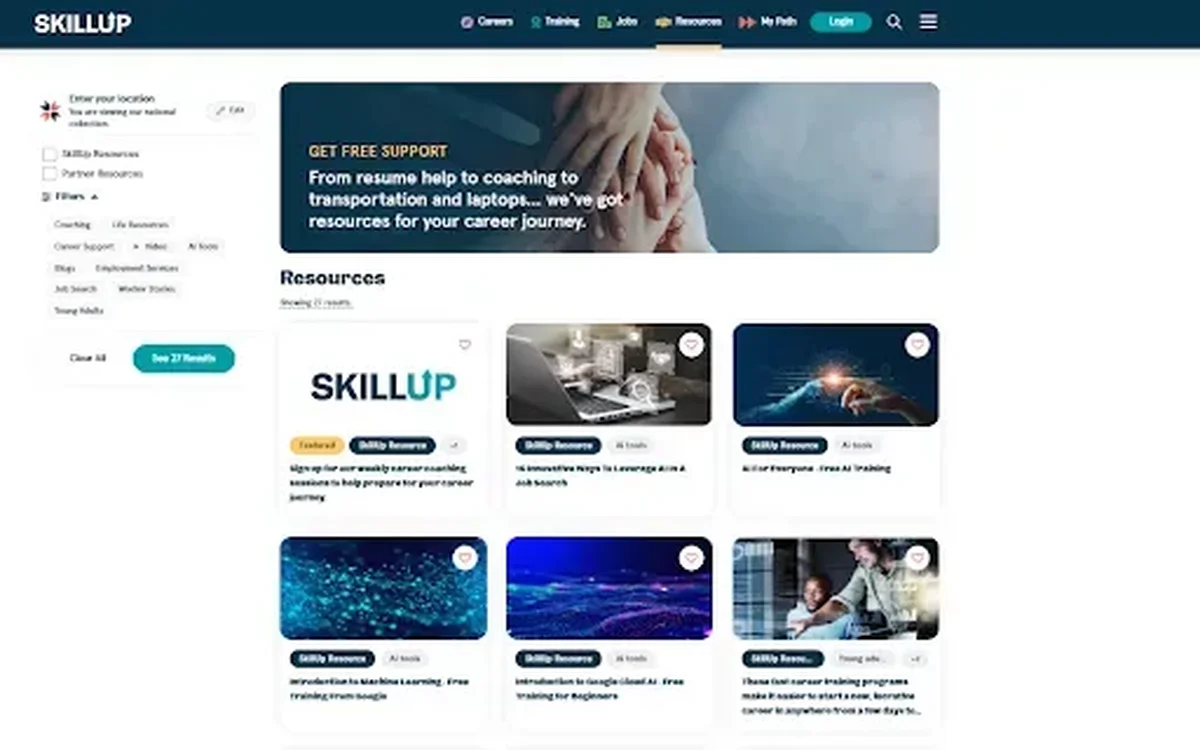
This is the category where SkillUp’s training catalog lives. Instead of bouncing between forty tabs comparing providers, you can view lots of options in one place and filter by online or local training, industry, career, work style, financial aid availability, and more.
SkillUp doesn’t directly provide training. We don't run the classes, take your application, or collect any tuition. Our team hand-picks programs from approved partners and lays them out in one place so you can compare what's out there. The free programs are free. The low-cost programs are low-cost. We're paid by foundations and partners, not by you.
The catalog pulls together programs from approved partners. The filters do the heavy sorting for you.
Open the catalog and you'll see filters for:
Try these power moves once you're in there:
The catalog is a tool, not a treasure map. If a filter combination leaves you with nothing, broaden one slider and try again.
WIOA stands for the Workforce Innovation and Opportunity Act. It's a federal law that sends roughly $3 billion a year to states for job training and workforce services. That money flows down to local workforce boards, which run American Job Centers (you may have heard them called One-Stop Career Centers).
Who qualifies for WIOA-funded training:
If you fit any of those, you may qualify for a training voucher worth several thousand dollars, plus support services like transportation help, childcare, and case management.
How to find your local American Job Center:
Heads up: the paperwork is the hardest part. The application takes time, the eligibility interview takes time, and the approved provider list does not include every program out there. That's annoying, and a lot of people give up at this step. Don't. For the right person and the right program, WIOA is the closest thing to a guaranteed training scholarship in the country, and the people staffing American Job Centers are there to help you get through it.
State-level funding sources to ask about while you're there:
Free does not mean good. Some free programs are excellent. Others are throwaway content with a worthless certificate at the end. Before you commit to any program, paid or free, run it through this check.
These should be published on the program's website or available on request. If a program will not share them, that is your answer.
Direct these questions to the program staff. Get them on the phone if you can. Their answers tell you more than the brochure.
Take the program length plus your living costs during that time, divided by the wage bump you'll get after. If a six-month program costs you $15,000 in lost wages and only adds $2 an hour to your pay, you'll spend three or four years just breaking even. That might still be worth it if the new job has stability and growth. It might not. The math is yours to do, and doing it puts you ahead of most applicants.
If the answers to all of this feel vague or defensive, trust that. Good programs are proud of their numbers.
You'll spot patterns faster once you've put a few programs side by side. Create a profile on SkillUp so you can save the trainings you're sizing up and compare cost, length, and outcome data in one place. The profile also unlocks free group career coaching sessions, which run every other week. Bring your shortlist to one of those if you want a second set of eyes on whether a program is worth your time.
Once you've picked a program and finished it, the next move is the job hunt. That's a whole other skill set, and we have a guide for framing what you've learned for the job you want when you're ready.
For now, cost should not be the wall that stops you. Affordable training exists. Sure, you have to do a little filtering and maybe some math and paperwork, but once you do, you’ll have a much shorter path to a job that fits your life better than the one you have now.
Many of them, yes. The catalog includes both free and low-cost programs, and the cost filter lets you sort by what fits your budget. SkillUp itself doesn't charge anything to use the platform, ever.
Often, yes. Many approved providers offer fully online or hybrid programs. Ask your American Job Center whether the program you want is on the state's approved provider list before you enroll, since funding only follows approved programs.
It varies by state and local office. Plan for two to six weeks between your first visit and an approved Individual Training Account. Some centers move faster, especially for in-demand fields like nursing, IT, and skilled trades.
You still have options. Employer-sponsored programs (Amazon, Walmart, Target, Starbucks), apprenticeships, community college workforce tracks, and non-profit bootcamps like Per Scholas all run without WIOA paperwork. Many of them are free for students who qualify.
Run it through the questions above. Look for published completion and placement rates, a recognized credential, and direct employer hiring relationships. If a program won't share its numbers or its employer list, take that as a warning sign.
"Free up front" usually means an Income Share Agreement, where you pay a percentage of your future salary back once you land a job. That's not the same as free, and the percentage can add up to thousands of dollars over a few years. Read the terms before you sign.