
As if finding a job isn’t hard enough, keeping a job when you don't have reliable childcare, stable housing, consistent access to food or dependable transportation is nearly impossible.
These are active barriers that can feel insurmountable and prevent people — especially those skilled through alternative routes (STARs) — from thriving in their work lives, no matter how motivated they are or how strong their skills might be. That's why SkillUp partners with organizations providing wraparound supports that address immediate survival needs standing between workers and their capacity to confidently pursue career growth.
A Stable Foundation Has to Come First
Career stability depends on far more than only career-related skills. It requires a strong enough foundation in life in order to dependably show up. If workforce development programs aim to spur more labor force participation, common structural barriers have to be addressed head-on. Recent research from the Federal Reserve Bank of Atlanta confirms what many families already know: childcare costs alone can consume up to 40% of household earnings.
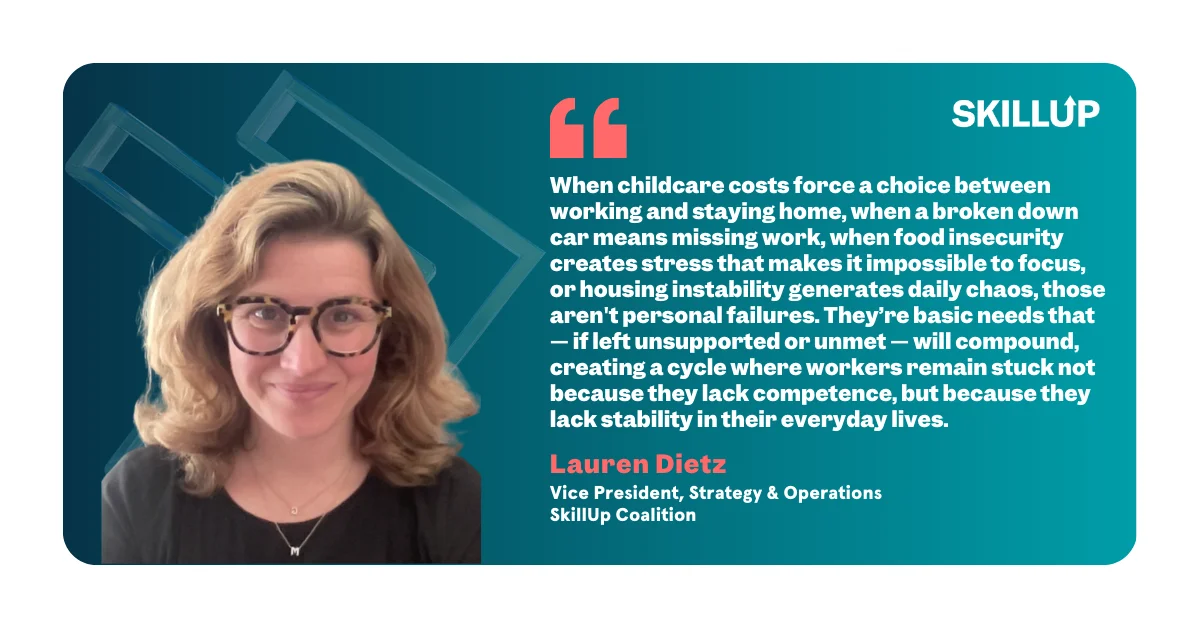
“When childcare costs force a choice between working and staying home, when a broken down car means missing work, when food insecurity creates stress that makes it impossible to focus, or housing instability generates daily chaos, those aren't personal failures,” said Lauren Dietz, Senior Director of Strategy & Operations at SkillUp. “They’re basic needs that — if left unsupported or unmet — will compound, creating a cycle where workers remain stuck not because they lack competence, but because they lack stability in their everyday lives.”
Local Partners That Meet Immediate Needs
In San Francisco's Tenderloin neighborhood, Code Tenderloin combines job training programs with childcare support, recognizing that parents can't focus on building technical skills if they're worried about their children's safety and supervision. Code Tenderloin’s approach acknowledges what many workforce programs miss: career advancement requires addressing the whole person's needs, not just their skills gaps.
For families facing housing and food insecurity in North Fulton, Georgia, The Drake House provides fully furnished private apartments, a food pantry, laundry services and transportation assistance to single mothers and their children experiencing homelessness. Rather than requiring families to first achieve stability before accessing support, The Drake House creates the stability families need to pursue education and employment. Residents work with family service managers to reduce debt, secure living-wage jobs and transition to market-rate housing, all while their children remain in their current schools and the family unit stays intact.
National Resources That Remove Friction
Transportation tends to be one of the most overlooked barriers to employment. Missing work because a car broke down or a bus didn't show up can cost someone their job. If there's no way to get to the grocery store, people go hungry. SkillUp elevates transportation services like Lyft Up that provide subsidized or free rides to help people reliably get to jobs, training, interviews, grocery stores and food assistance programs. When transportation becomes less of a variable, people can find stability.
Veterans and Military Families Face Distinct Challenges
For veterans and military families, these needs take on additional complexity. Military spouses often face employment gaps due to moves between bases. Veterans may need support accessing VA benefits, addressing service-related trauma that affects their ability to work or translating military skills into civilian relevancy. Frequent relocations disrupt childcare arrangements, healthcare access shifts from military to civilian systems and housing transitions create their own form of instability.
“Military families face unique challenges that civilian workforce programs and organizations often overlook,” said Amanda Snyder, Marketing Manager at SkillUp and a military spouse herself. “We have curated resources that recognize those complexities, helping connect service members and their families to the right support faster.” SkillUp's Resources for Veterans Guide points service members and their families to specialized resources and services including career transition assistance, mental health resources, educational benefits navigation and programs specifically designed for military career intricacies. “Our guide was fully designed with the lived experience of military families in mind,” said Snyder.
What’s Next
We know that more people will be able to thrive if they have access to the resources that address these key needs. SkillUp continues to expand partnerships and relationships across local, regional and national organizations, and will keep building out resources tailored to populations with distinct needs, including veterans, military families, parents, youth and workers navigating unstable circumstances.
Economic mobility can only happen when basic needs are met and workforce development can't happen in isolation from basic needs. “When we connect STARs to quality training and deeply-vetted job opportunities without also connecting them to childcare, transportation or other key support, we're setting them up to fail despite their — and our — best efforts,” said Dietz. “Real economic mobility requires addressing the full spectrum of barriers that prevent people from accessing opportunity in the first place.”
Are you and your organization ready to join us in our mission to support STARs in building stable, thriving careers? Connect with us to learn how we can partner together.


