
In the San Antonio metro area, more than 461,000 adults have some college experience but never finished their degree or credential. That translates to roughly 21% of the region's adult population. These are workers who started something, had a plan, and then life got in the way. Maybe it was a shift change at work, or a new baby. Possibly an unexpected transportation breakdown, or a medical bill that took precedence. These aren’t personal failures; rather, the system failed to provide the support people need to persist through life’s wild cards.
Asking why they stepped away from their learning trajectory is the wrong question. Instead, we need to focus on what it takes to bring these learners back, what type of program, whether an associate’s degree, short-term credential, or even an apprenticeship, serves their goals, and what supports should be in place before we ask them to try again.
A Population Motivated to Return to Learning, With the Right Support
Data on San Antonio's stop-out population from our SkillUp Pulse User Survey tells a story about motivation, not apathy. Among SkillUp users in the region who identify as having some college but no credential, 68% are currently unemployed — more than double the rate of other educational attainment groups in the area. Yet 74% say they plan to enroll in training, compared to a 50% baseline across all other groups. These workers haven’t given up on their goals, despite their hurdles.
Re-engaging people who have stopped out requires more than sending information about available programs. Research on adult learner re-enrollment shows it takes seven or more meaningful touchpoints over a year or longer before people commit to returning.
The barriers aren't only logistical. Many carry institutional distrust built from a prior training or development experience that didn't deliver on its promises, financially, professionally, or personally. Any re-engagement strategy has to acknowledge that reality before it can move past it.
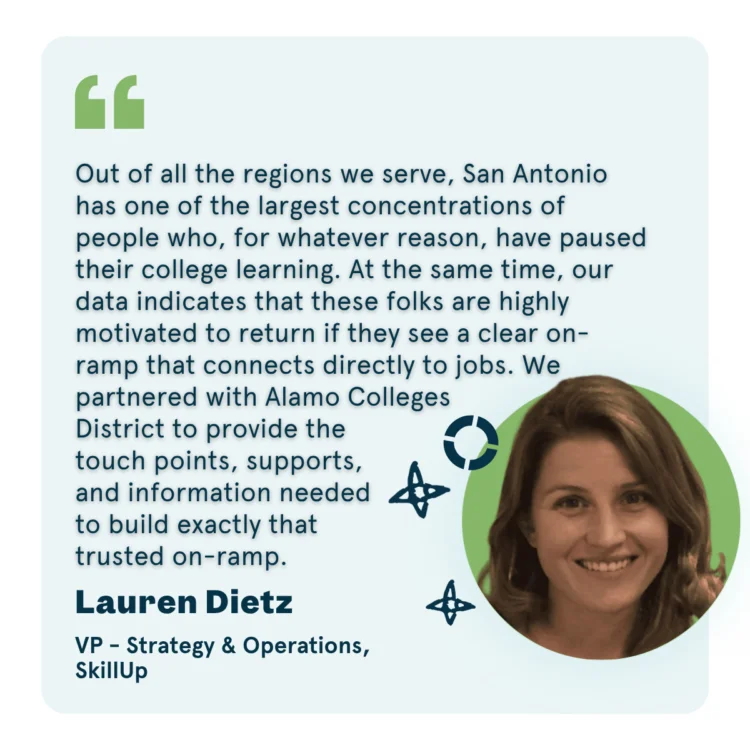
"Out of all the regions we serve, San Antonio has one of the largest concentrations of people who, for whatever reason, have paused their college learning," says Lauren Dietz, Vice President, Strategy & Operations at SkillUp. "At the same time, our data indicates that these folks are highly motivated to return if they see a clear on-ramp that connects directly to jobs. We partnered with Alamo Colleges District to provide the touch points, supports, and information needed to build exactly that trusted on-ramp."
What the Partnership Actually Does
SkillUp and Alamo Colleges District — a five-college system that has served the San Antonio region for 80 years — worked together to build a targeted re-engagement campaign specifically for stop-out learners in the San Antonio-New Braunfels metro area. CredLens then comes in to validate job placement and wage outcomes for the program. The model is built on the straightforward premise that co-branding with a trusted local institution reduces the skepticism that may prevent motivated workers from taking the first step, while SkillUp's platform provides the career navigation infrastructure to help them find the right program and move toward employment.
Alamo Colleges District has continued to expand its workforce training programs, making this partnership a natural extension of both organizations’ commitment to connecting more people with meaningful education and career opportunities.
At SkillUp, all our regional catalogs feature only rigorously vetted, high-growth, high-wage occupations with credentials obtainable in under a year for under $10,000 — and the vast majority cost less than $5,000. In the San Antonio area, Alamo Colleges District contributes 53 of the 125 programs spanning skilled trades, healthcare, transportation and logistics, and more. Programs range from an eight-month Electrical Trades certificate to a four-month Phlebotomy certificate, and even a CDL program that can be completed in just five weeks across multiple campuses.
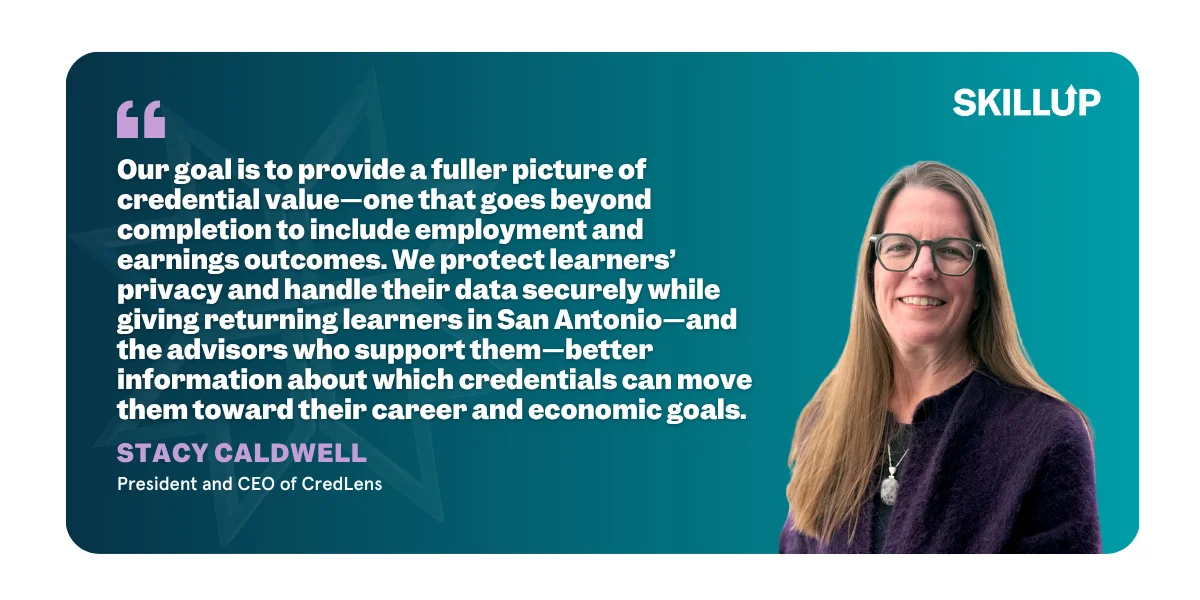
CredLens, our third-party validating partner in this work, tracks post-graduation placement and wage outcomes at scale for Alamo-affiliated programs. “Our goal is to ensure we define a credential’s value beyond just completion rates, incorporating data that measures the economic mobility that credential achievers experience,” said Stacy Caldwell, CEO at CredLens. “This privacy-protected data can help guide other people’s decisions to obtain a credential, and instill confidence that their chosen path has a valuable return on investment.”
Our goal is to reach 12,600 people who stopped out and support 630 placements in high-opportunity jobs that pay an average hourly wage of $18.95, growing to $20.33 as the program scales.
A Regional Model That Can Be Replicated
The San Antonio Stop-Out Initiative is one example of how SkillUp continues to think about regional partnerships as critical trust infrastructure. Partnerships with organizations that already have established credibility, like community colleges, regional workforce boards, and local nonprofits, are the ones best positioned to reach populations that may be skeptical of new platforms asking them to try again.
“San Antonio is home to nearly half a million people who started something and didn't get to finish,” says Dietz. “We are working to bring those learners back to the workforce; they just need the right on-ramp to get there.”
When we partner intentionally, we enable a multiplier effect. Local organizations bring the regionally aligned programs, employer and community relationships, and years of credibility. We bolster their reach by providing the career navigation tools, quality-vetted catalogs, and data infrastructure to reach the folks who need our collective support the most.
If this model resonates with you and your organization, we’d love to connect. Learn more at https://skillup.org/partnerships/partners