Why we hosted this conversation
The question we keep hearing
Almost every week, a funder, employer, or workforce partner asks us some version of the same thing: what should AI actually do in our work, and what should it never do?
It’s the right question. AI is already changing how people search for jobs, how employers screen candidates, and how programs deliver coaching. Used well, it can help us reach millions more STARs (people skilled through alternative routes) with better information, sooner. Used carelessly, it hands the people with the least margin for error a chatbot, while everyone else gets a coach.
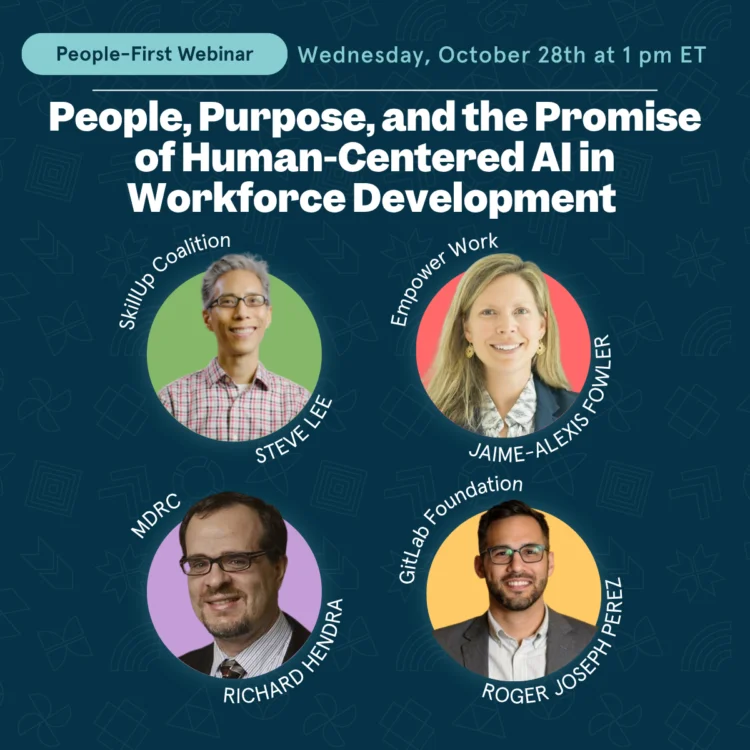
So we brought together four people who see this from very different seats:
- Steve Lee, CEO, SkillUp Coalition (host)
- Jaime-Alexis Fowler, Founder & CEO, Empower Work
- Roger Joseph Perez, Fund Director, GitLab Foundation
- Richard Hendra, Director of Data Strategy, MDRC
If you only have a minute
Three takeaways
- Let AI do the busywork
Use it for sorting, matching, and mapping. Save people for the moments that decide whether someone keeps going. - Test in weeks, not years
Rapid, rigorous trials keep pace with the technology and stop promising tools from being cut too early. - Keep human help universal
If coaching becomes a luxury and chatbots become the default for everyone else, AI widens the gap it should close.
The conversation
Six questions, answered by the panel
We’ve organized the hour around the questions that shaped it: three big ones the panel kept circling back to, and three that came straight from attendees in the live chat. Each has a short answer up top if you’re skimming, and the fuller conversation underneath. You can watch the full conversation here.
- Where should AI stop and a person step in?
- How do you evaluate a tool that changes every few months?
- Could AI make the opportunity gap wider?
- How do we prepare workers for jobs that don’t exist yet?
- If AI is the front door, what about people who can’t reach it?
- How do we train for careers that won’t be automated away?
Part one · The big questions
Where should AI stop and a person step in?
The short answer
AI is great at the logistics of a career search. It isn’t built for the moments that decide whether someone keeps going.
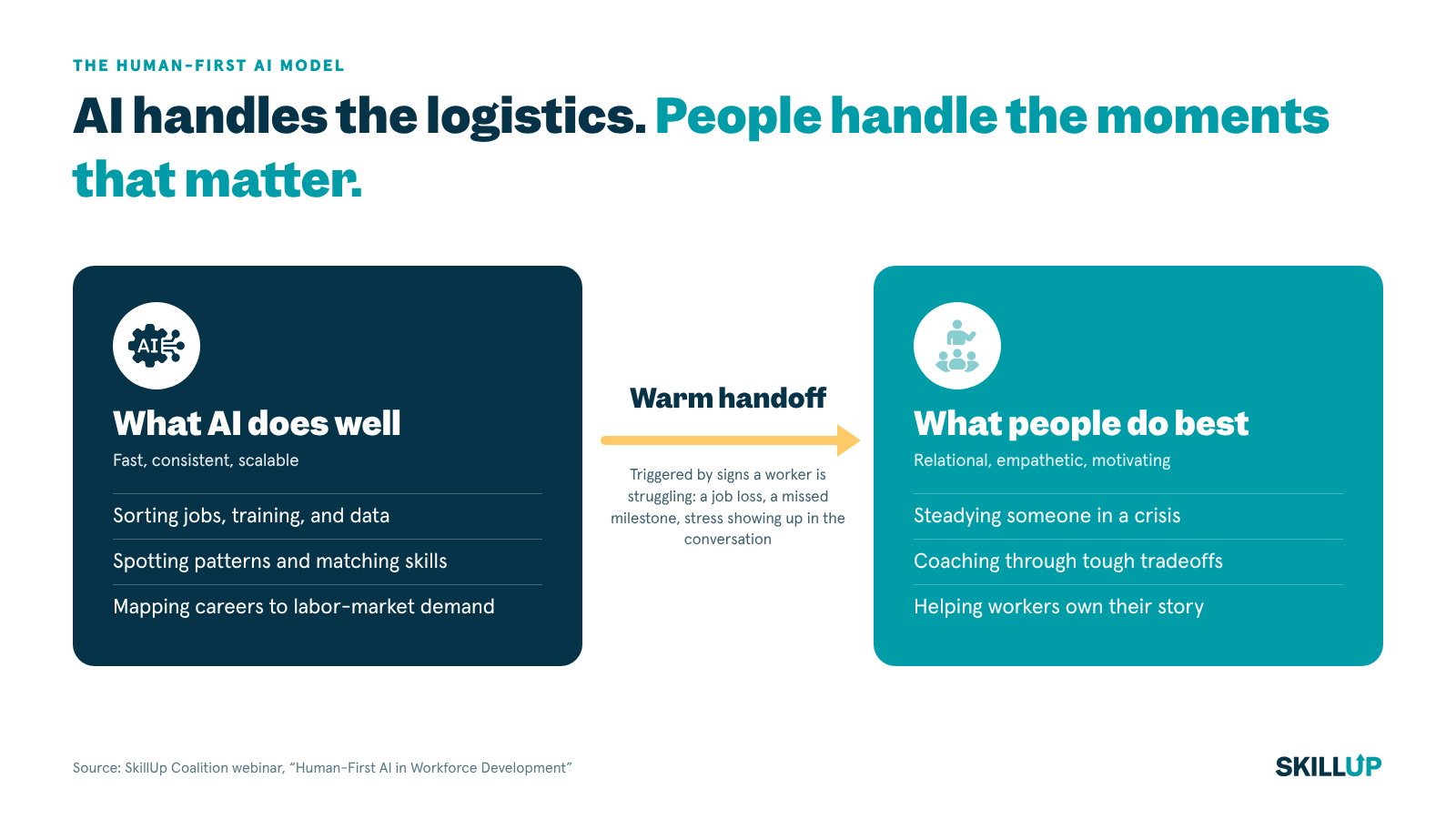
Think about what looking for a better job actually feels like. Part of it is logistics: sorting through openings, figuring out which skills transfer, comparing training options. AI is genuinely good at that. It can spot patterns and understand what someone is asking for, at a scale no team of coaches could match.
But a lot of career navigation is emotional. Someone just got laid off. Someone is trying to finish a certificate while covering rent and childcare. In those moments, understanding the request isn’t enough. People need someone who can feel the weight of what they’re carrying and help them find the energy to take the next step.
The panel put it in terms of empathy. There’s understanding what someone means, feeling it with them, and motivating them to act. Today’s AI can manage the first. The other two are still human work.
The model that came out of the conversation is simple: let AI carry the routine work, and design a warm handoff so that when a worker shows signs of struggling, they reach a real person quickly.
How do you evaluate an AI tool when the technology changes every few months?
The short answer
Fast, rigorous, and continuous. Not a five-year study.
A traditional evaluation can take years. By the time the report comes out, the model you tested has been replaced several times over, and the findings describe a tool nobody uses anymore.
SkillUp and MDRC have shown there’s another way. Rigorous randomized controlled trials can be scoped and run in as little as three weeks by tracking early signals, like how workers engage with a tool, instead of waiting on outcomes years down the road.
Speed matters for a second reason, too. New tools often get worse before they get better. Teams that only check in once a year tend to see the dip and pull the plug. Continuous evaluation lets you see the turn coming.
And the evidence so far points in one direction: people supported by AI outperform people working alone or AI tools working alone. The goal isn’t to choose between them.
Could AI make the opportunity gap wider?
The short answer
Yes, if we let it. Avoiding that is a design choice.
Here’s the risk the panel didn’t want anyone to miss: a two-tier system. People with resources get coaches, networks, and personal guidance. Workers without degrees get a chatbot. That isn’t innovation. It’s the same opportunity gap with a better interface.
The way out runs through the people who fund and build the systems. Invest in open, shared infrastructure that guarantees real, relationship-based career support for every worker, regardless of income, and use AI to stretch that human capacity further rather than replace it.
Part two · From the chat
Some of the sharpest questions of the hour came from attendees. Here’s what they asked, and how the panel responded.
How do we prepare workers for jobs that don’t exist yet?
“How do workforce orgs prepare learners and workers for jobs that do not yet exist in the AI future of work? Should we reskill for enterprise jobs or grow the pie through entrepreneurship?” -Webinar participant
The short answer
Don’t chase job titles. Follow the investment, and build skills that travel.
Nobody can tell you the exact job titles of 2035. But you can see where money is moving right now. Public and private dollars are flowing into advanced manufacturing, clean energy and the power grid, and data centers. Those investments turn into jobs, and those jobs need people.
Then focus on what lasts. Technical skills change with every wave of disruption. Problem solving, sound judgment, clear storytelling, and the ability to work across teams don’t expire.
Finally, help people build from what they already have. Most workers don’t need to start over with a four-year degree. They need someone, and a good tool, to show them how their existing skills map onto an adjacent, better-paying path. Whether that path leads to an employer or to a business of their own, that foundation is the same.
What this means for you: Before launching a new training track, check it against where infrastructure investment is landing in your region, and make sure it builds durable skills alongside technical ones.
If AI becomes the front door, what about people who can’t reach it?
“Our study found 18% of people connected with a device, internet, and in-person help found new jobs without enrolling in a workforce program. As AI becomes the front door, how should funders and workforce orgs value that first step of digital readiness?” -Webinar participant
The short answer
Treat digital access as step one, not a side project.
That 18% figure got a lot of reaction. Nearly one in five people found a new job with a device, a connection, and some in-person help, without a formal program. That’s a powerful case for the basics.
The panel’s point: if AI becomes the way people enter career services, a lot of people won’t make it through the door. AI-driven career navigation can’t help someone who doesn’t have a device, reliable broadband, or confidence using them.
It also can’t help someone whose biggest worry is this week. More than 70% of coaching conversations with low-wage workers start with immediate pressure: fear of losing a job, or how to cover food, childcare, and transportation. A platform that skips straight to “here are your recommended careers” will miss most of the people it was built for.
What this means for you: Count digital access and basic-needs support as part of the workforce system, not something next to it, and fund them that way.
How do we train for careers that won’t be automated away?
“When companies investing heavily in AI are simultaneously reducing workforces, how do we ensure we are training people for viable careers rather than roles being automated away?” -Webinar participant
The short answer
Use what decades of evidence already tell us, and check every pathway against real demand.
Layoffs tied to automation feel new, but labor market disruption isn’t. Forty years of evidence on subsidized employment, rapid retraining, and coordinated case management still applies. We don’t have to start from scratch.
It’s also worth noticing who gets cut. Often it’s the people who held organizations together: the connectors who made work happen across teams. That kind of human glue is exactly what AI can’t replicate, and it’s worth naming when you prepare workers for what’s next.
And keep training honest. Vet every pathway against real-time employer demand, credentials that actually carry weight with employers, and living wages. That’s how you avoid preparing people for jobs that are already on their way out.
What this means for you: Review your training catalog at least annually against current job postings and wage data, and retire pathways that no longer lead to living-wage work.
The human touchpoint
What a warm handoff sounds like
Everything in this conversation comes back to one moment: the point where a worker needs more than information. Here’s what that moment looks like when the system works.
“Chatting with my peer counselor was a grounding experience. These last few decades have been rough and the past few years even harder. But in that conversation, I felt heard, supported and valued. I can’t thank the coaches who dedicate their time to helping people like me enough.”Empower Work texter, connected through SkillUp
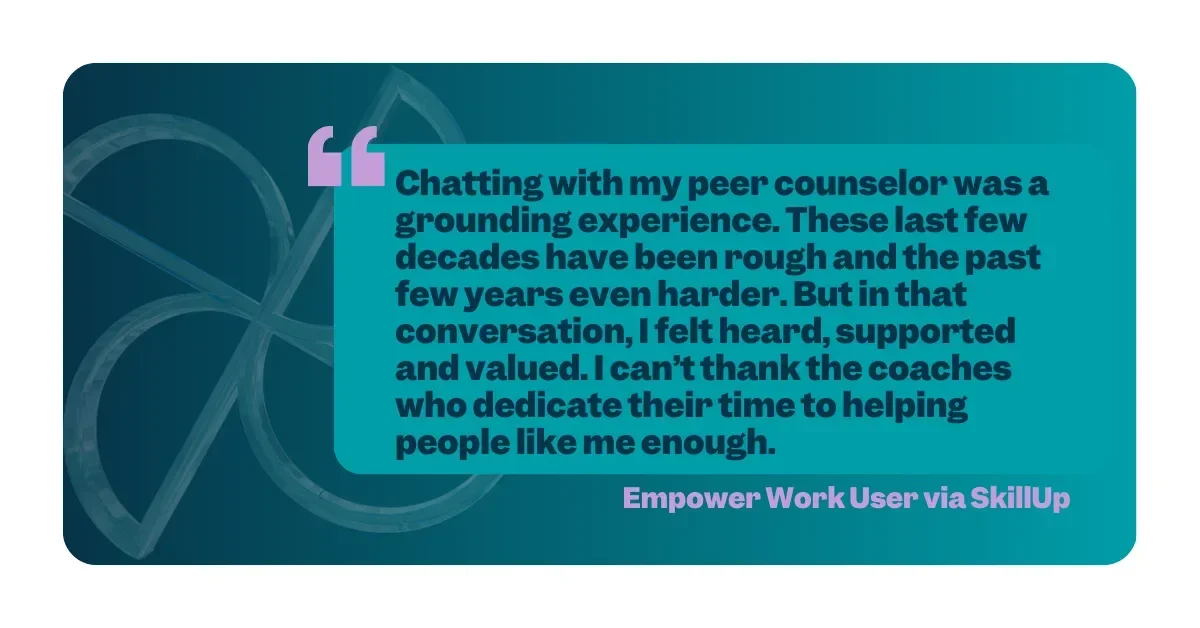
This worker found their way to SkillUp looking for a path forward. Through our partnership with Empower Work, whose founder Jaime-Alexis Fowler joined us on the panel, they were connected by text to a peer counselor. No algorithm made that conversation matter. A person did.
That’s the warm handoff in practice. Technology helps workers find the door and get through it faster. A person is there for the moments that are hard. One without the other isn’t enough, and building both, together and at scale, is the work ahead.
What to do next
For philanthropic and public funders
Fund the infrastructure, not just the pilot. Prioritize long-term worker data and shared systems over one-off software experiments, and back programs that show measurable social return and evaluate in the open.
For employers
Take a hard look at your degree requirements. Adopt skills-first hiring and partner with SkillUp to reach skilled STARs who are ready to contribute on day one.
For technology and regional partners
Don’t build what already exists. SkillUp’s platform and API bring it all together in one place: our AI-powered My Career Coach, already helping thousands of workers every month, plus 20,000+ open, living-wage jobs and 8,000+ vetted short-term training programs. Your users get human-first career guidance, and your team skips years of engineering.
For researchers and analysts
Learn alongside us. With MDRC, SkillUp is building a longitudinal picture of how workers without degrees move through the labor market: rapid trials that test AI tools in weeks, and a Pulse Survey three times a year that follows workers’ progress, barriers, and wages across two years. We’re sharing what we learn as it comes in, and we’re looking for research partners who want to dig into the data with us.
For anyone
Catch the full recording to hear even more.