For Job Seekers
For Career Exploring
Become a Partner
Search

You're considering a training program that could help you land a better-paying job. Then you see another headline warning that AI might replace the very career you're training for. So maybe you start to think, “Should I change my plans?”
It's a concern shared by millions of Americans. According to a 2026 Pew Research Center survey, 71% believe AI will lead to fewer U.S. jobs over the next 20 years.
But a prediction about the entire economy isn't a prediction about your career. And as we've seen from our own users, people have very different feelings about AI's potential. Let's look at what the research actually shows, where the risks are, and what you can do about them.
AI is already changing workplaces. But the evidence that it's eliminating jobs across the entire economy is much less clear than some headlines suggest.
An October 2026 report from Yale's Budget Lab found no clear evidence of widespread changes in employment attributable to AI.
That's encouraging, but there's more to the story.
In August 2026, Stanford's Digital Economy Lab reported a concerning trend among workers ages 22 to 25. Jobs heavily exposed to AI grew 19% slower than comparable jobs with low AI exposure.
The difference appeared to come primarily from reduced hiring rather than increased layoffs. Researchers also cautioned that their findings don't prove AI caused the gap. Other economic factors may be involved.
So what does that mean if you're looking for work?
Younger workers entering certain fields may be facing real challenges, even though the broader economy hasn't experienced widespread AI-driven job losses.
And the uncertainty is affecting career decisions. In a Jobs for the Future (JFF) survey conducted in late 2025 and published in 2026, 44% of people ages 16 to 34 said they'd considered changing careers because of AI.
We won’t tell you to ignore those concerns. But we also don’t recommend abandoning a career you're interested in because someone predicts AI will eventually replace it.
National research tells us how Americans feel about AI. But what about people who are actively thinking about their careers?
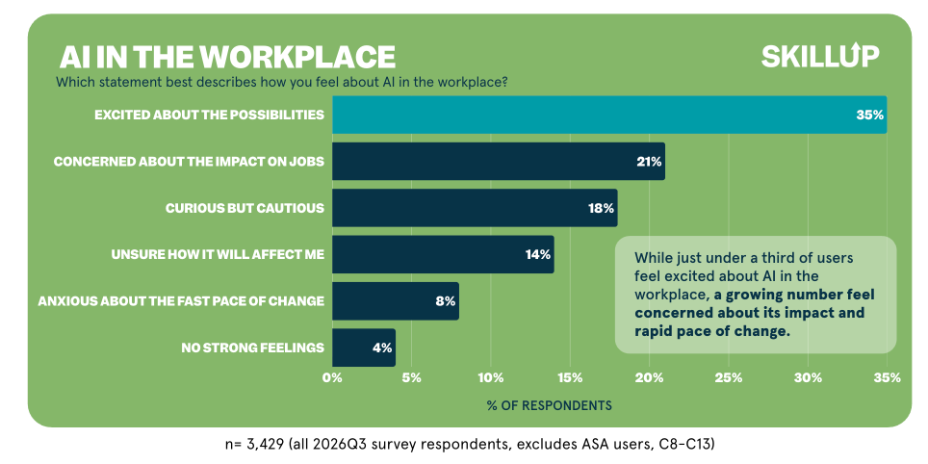
In SkillUp's Q3 2026 Pulse survey, we asked 3,429 respondents which statement best described how they felt about AI in the workplace.
The most common answer was positive: 35% said they were excited about the possibilities.
But enthusiasm wasn't universal. Another 21% were concerned about AI's impact on jobs, while 18% described themselves as curious but cautious. Meanwhile, 14% weren't sure how AI would affect them personally, and 8% felt anxious about the rapid pace of change. The remaining 4% had no strong feelings.
That's a pretty wide range of reactions from people thinking about work and their futures!
And it makes sense. You might be excited about technology that could make your job easier while worrying about what happens if your employer starts using it to replace certain tasks.
The survey doesn't tell us how many jobs AI will eventually affect. It does tell us that excitement, concern, and uncertainty all have a place in this conversation.
At SkillUp, we don't think you need to choose between embracing AI and being afraid of it. You can be interested in what the technology makes possible while asking reasonable questions about what it means for your career.
Before making a big move, learn how to evaluate a career change based on your skills, financial needs, and the opportunities available to you.
Whether you're excited about AI, concerned about your job, or somewhere in between, the question you should ask is how the technology might change the work you do. There's an important difference between AI changing a job and AI replacing it.
Think about the work you do during a typical shift. Some responsibilities follow predictable steps. Others require physical work, communication, judgment, or the ability to figure out what to do when something unexpected happens.
AI may be able to help with certain responsibilities without being able to perform the entire job.
Consider two examples:
Both careers could change as technology improves. Neither example tells us whether employers will ultimately hire more or fewer people.
Stanford's research offers another useful distinction. Employment declines among younger workers were concentrated in occupations where AI tends to automate tasks. In occupations where AI is used more to assist workers, employment was generally stable or increasing, particularly among experienced employees.
That doesn't guarantee a particular career will remain secure. It does suggest that how AI is used in an occupation matters as much as whether AI is used at all.
You'll find plenty of lists promising careers that AI will never replace. Be skeptical of those promises.
Nobody can guarantee that an occupation will stay the same. And a training program advertising "future-proof skills" can't actually see the future. Instead, investigate what employers need today.
Start with the Bureau of Labor Statistics Occupational Outlook Handbook. You can research typical job responsibilities, training requirements, wages, and projected employment growth.
Then look at current job postings in your area. Pay attention to whether the work involves hands-on responsibilities, digital tasks, customer interactions, or a combination of these. Look for technology skills that employers repeatedly mention, and check whether they're required or simply preferred.
At SkillUp, we can also help you explore career paths that don't require four-year degrees, including opportunities in healthcare, skilled trades, technology, and other industries.
You may find a career that builds on your existing experience while giving you room to learn new skills.
And don't rule out an occupation just because its workers use AI. Learning to use new technology can be part of growing in a career, not necessarily a reason to leave it.
If you've applied to dozens of jobs without hearing back, you might wonder whether an AI system rejected your application before anyone read it.
It's possible that automated hiring software played a role. But not every employer uses AI to review applications, and not every applicant tracking system (ATS) uses AI.
An ATS can store resumes, organize candidates, and filter applications based on criteria selected by employers. Some employers also use AI-assisted tools to evaluate or rank applicants. The exact process varies by employer and software.
And AI isn't the only reason an employer might reject someone or never respond.
JFF's 2026 report found that job seekers held mixed views on AI's impact on their job searches. Among respondents, 46% believed AI hadn't affected their ability to find employment, while 28% believed it made finding a job easier and 26% believed it made the process harder.
These are people's reported experiences, not proof that AI caused particular hiring outcomes.
Still, job seekers are changing how they apply.
An October 2026 survey by Greenhouse, a hiring software company, found that 77% of 1,200 U.S. job seekers had used AI during their search in the previous year. At the same time, 60% had changed or considered changing how they wrote applications because they worried about sounding AI-generated.
It's a strange situation. People are using AI to compete for jobs while worrying that employers might judge them for using it.
You can't control every employer's hiring process. But you can make your experience easier to recognize.
Read each job posting carefully and identify the qualifications you actually have. Then make sure your resume describes that experience using clear, relevant language.
Suppose you've spent several years working in retail and want to move into an administrative position.
You might already have experience maintaining records, coordinating schedules, training coworkers, or handling customer questions. Those responsibilities could be relevant to administrative work, even though your previous job title was different.
The important part is explaining what you've done without exaggerating it.
You might. But you probably don't need to become an AI expert to keep building your career. The skills worth learning depend on the work you want to do.
Someone in an administrative position might benefit from learning AI-assisted scheduling or document tools. A warehouse employee may need experience with updated inventory software. A healthcare worker might need training on new digital record systems.
In each case, the goal is to learn something employers need, not simply add AI to your resume.
JFF's research found that just 31% of surveyed workers without four-year degrees had received AI training at work, compared with 37% of respondents overall.
If your employer introduces new software without explaining how to use it, you're being asked to adapt without much support.
And if you're already looking for a new job, you may not have an employer who can provide training at all.
That doesn't mean you need to pay for a course immediately. If you're currently employed, ask your manager what technology the company plans to introduce, how your responsibilities might change, and whether training will be available.
If you're looking for a new job, start by reviewing postings in the field you're interested in. Which software or technical skills come up repeatedly? Which ones could you learn through free resources or practice?
You might discover that you need to learn one program, not complete an entirely new training course.
Upskilling means building on your existing abilities. Reskilling means learning new skills to move into a different type of work.
Both can be valuable, but they solve different problems.
For example, someone who already works in logistics might learn new inventory management software to qualify for a position with more responsibility. Someone moving from food service into IT support might need training in an entirely different set of technical skills.
Our introduction to upskilling explains how to approach both options.
If you need formal training, compare programs based on their cost, schedule, credentials, and connection to available jobs. SkillUp's training catalog can help you research affordable, accessible programs from independent training providers.
You can also investigate earn-and-learn opportunities, which combine paid employment with training or financial assistance for education.
Remember, completing training doesn't guarantee you'll be hired. Before spending money, make sure the qualification is something employers in your chosen field actually value.
Absolutely, if you use it for the right things.
AI can help you organize information, compare job descriptions, practice interview questions, and find connections between the skills you already have and the requirements for a new position.
Imagine you're considering a career in healthcare administration after several years in retail.
You could give an AI tool a job description and ask it to identify which responsibilities overlap with your experience. It might point out connections involving customer service, scheduling, recordkeeping, or computer systems.
You'd still need to check the employer's requirements. But that comparison could give you a clearer starting point.
You could also practice interviewing with an AI chatbot. Ask it to take the role of a hiring manager, give you questions one at a time, and provide feedback on your answers.
That's something you can do at home, even if you don't have another person available to practice with.
Our guide to free AI job search tools and prompts includes examples you can try yourself.
A common problem with AI-generated resumes is that the tools sometimes make ordinary responsibilities sound more impressive than they really were.
Suppose you tell a chatbot that you helped train new employees. It might rewrite that as a claim about managing an organization-wide training program. Those aren't the same thing.
If you couldn't explain a statement confidently during an interview, it probably doesn't belong on your resume.
Use AI to organize your experience, identify relevant skills, and make your writing clearer. Keep the facts and final decisions in your hands.
AI can provide useful information. It can also provide inaccurate information with remarkable confidence.
A chatbot might recommend a training program based on outdated requirements, give you an incorrect salary estimate, or misunderstand how professional licensing works in your state.
And while a chatbot might sound authoritative about licensing, it isn't the licensing board.
Before making an important career decision, verify the information with the organization responsible for it.
For example:
Be cautious about unexpected job offers, too. The Federal Trade Commission's guidance on job scams explains common warning signs, including requests for money or sensitive financial information before you've been hired.
AI can help you research options, but it shouldn't be the only source you consult before spending money or making a major change.
We're exploring how AI can make career guidance more accessible, too.
SkillUp's personalized AI tool, My Career Coach, is in public beta. It's designed to help people explore career questions, consider opportunities, and receive guidance through ongoing conversations.
We're also being careful about how we evaluate it.
An independent September 2026 report from MDRC examined SkillUp's earlier AI experiments. The first chatbot actually made users less likely to view job and training opportunities than people browsing the traditional website. We discontinued that version and used what we learned to develop newer tools.
Early results from My Career Coach are encouraging in terms of engagement, but researchers haven't yet established whether it helps people achieve better employment outcomes.
We believe AI can be useful for career guidance. We also believe you should have the choice to use it or find information another way.
You can explore SkillUp's careers, training, and jobs without an AI coach. And if you'd rather hear from a person, our free career coaching resources include on-demand advice from Coach Kyle and text-based support through our partner Empower Work.
You don't need a ten-year prediction about AI to start making a career plan. Instead, focus on what you can learn about your options right now.
Think about the work you enjoy, the skills you've developed, and the income you need.
If you're unsure where to start, our guide to work styles and careers that fit can help you identify possible directions.
Pick one or two occupations worth investigating. You don't have to commit to either one yet.
Look at several openings for the same type of position in your area. Which requirements appear repeatedly? Do employers ask for particular credentials, computer skills, or previous experience? Separate the qualifications you already have from those you'd need to develop.
Pay attention to wages, too. A new career should help you move toward your financial goals, not simply offer different work.
Choose a skill that could help you qualify for the job you're considering. Find out whether you can learn it through your employer, free resources, short-term training, or an earn-and-learn opportunity.
If formal training is required, compare the costs and verify the credential before enrolling. There's no reason to pay for an AI course if the position you're pursuing actually requires something else.
Sometimes the difficult part of changing careers isn't finding information. It's deciding what to do with it.
You might be comparing two training programs, wondering whether your work experience qualifies you for something new, or trying to figure out how to make a career change while paying your bills. That's where career guidance can help.
And when you're ready to start looking, SkillUp's job board can help you find opportunities that meet our standards for wages, qualifications, and career potential.
The experience you've already gained counts! You may be closer to a new career than you realize.
AI will change how people work. Some jobs may require different skills, some workers may face fewer opportunities, and new types of work may emerge.
We can't know exactly how every occupation will change. But you can make decisions using the information available today.
Look at what employers need. Learn which parts of your experience transfer to new roles. Compare realistic training options, and don't let a headline push you into spending money before you've done your research.
You don't have to become an AI expert to build a career with room to grow. And you don't have to figure everything out at once.
Choose one career worth exploring, find out what it takes to qualify, and start there.
Want to explore a particular part of your career journey in more detail? These free SkillUp resources can help.



To get a plumbing apprenticeship, find a local training sponsor or participating employer, check its entry…